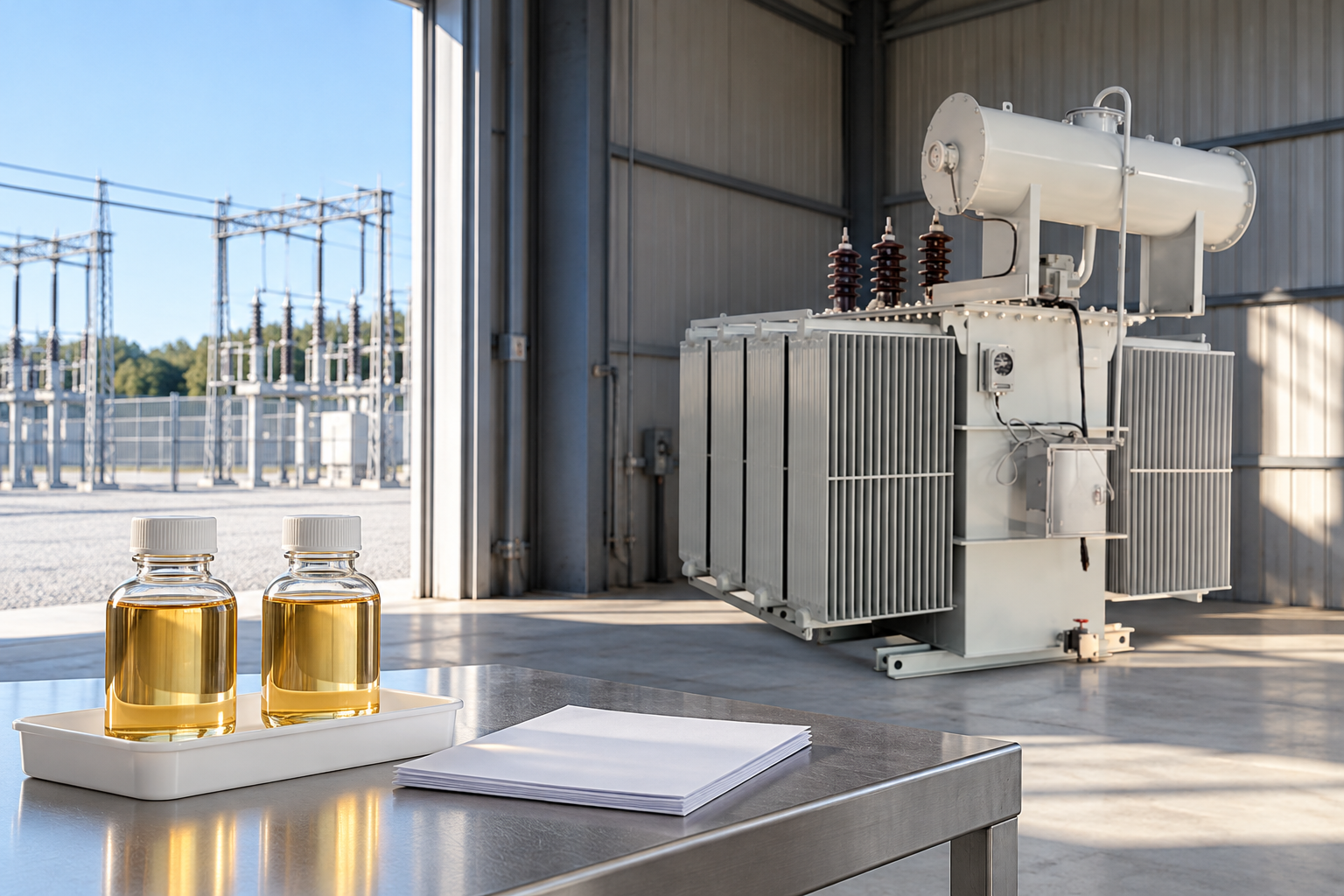

The transformer vector group fixes winding connections, phase shift, and earthing behavior—decisions that outlast every other line on the nameplate.
Distribution projects mostly choose among a handful of groups, yet the wrong pick complicates earthing, unbalanced loads, and future paralleling. This practical guide explains the notation and the selection logic.
Check your network earthing practice and existing units before locking the group in the RFQ.

Part 1. Reading vector group notation
Dyn11 means a delta high-voltage winding, a star low-voltage winding with the neutral brought out, and phase displacement at clock position 11.
Capital letters describe the HV side, lowercase letters the LV side, and the digit gives the LV position relative to HV in 30-degree clock steps.
For related context, see the distribution transformer types and applications overview.
For related context, see the distribution transformer kVA calculation guide.
Part 2. Common vector groups compared
Most distribution projects select from a short list of standard groups.

| Vector group | Typical use | LV neutral | Notes |
|---|---|---|---|
| Dyn11 | Mixed LV distribution loads | Yes | Common default in many 50 Hz networks; tolerates unbalance well |
| Dyn5 | Networks standardized on clock 5 | Yes | Same behavior family as Dyn11 with different displacement |
| Yyn0 | Light, well-balanced loads | Yes | Sensitive to unbalance without a delta path |
| YNd11 | Step-up and HV earthing duties | No | HV neutral available, delta LV winding |
| Dd0 | Industrial systems without LV neutral | No | Needs a separate earthing transformer where required |
Confirm the exact group on the nameplate draft; the vector group and tap range appear together in the ratings section.
Part 3. Earthing and unbalanced load behavior
A delta HV winding gives zero-sequence current a circulating path, which keeps the LV neutral stable under unbalanced load.
Star-star groups without a delta can shift the neutral point when single-phase loads dominate; some designs add a tertiary winding to compensate.
Match the LV neutral arrangement to your earthing system before weighing anything else.
Part 4. Phase shift and paralleling constraints
Transformers only parallel when phase displacement matches: a Dyn11 unit cannot share a bus with a Dyn5 unit even at identical voltages.
Plan replacements and expansion around one displacement family per site.
Where two groups must interconnect, do it through the network, never on a common LV bus.
Part 5. Matching the group to network practice
Utilities and industrial owners usually standardize one group per voltage level; follow the local standard unless a study justifies deviation.
In export projects, ask the end client for their reference group early—field conversion is not possible.
Record the choice and its reasoning in the specification so future engineers do not reopen it.
Part 6. Product recommendation and Fit Boundary
Product recommendation: Vector group is a series-level attribute—confirm it at category stage before model drawings. Start at the transformer product category, then review the S□-M oil-immersed power transformer series and the SC(B) resin insulated dry transformer series against the approved specification.
| Better fit | Poor fit without extra study |
|---|---|
| Projects following an established network group standard | Choosing a group from a random catalog page |
| Sites with defined earthing and neutral requirements | Ignoring existing units the new transformer must parallel |
| Buyers recording displacement for future expansion | Assuming any star LV suits heavy single-phase load |
Submit the rated kVA and voltage combination, vector group and tap range, no-load and load losses, cooling method and enclosure, and short-circuit impedance target through Contact Us for model-specific confirmation.
Part 7. Common vector group mistakes
- Ordering Yyn0 for feeders dominated by single-phase load.
- Paralleling units with different clock numbers on one bus.
- Omitting the LV neutral where the earthing system requires it.
- Copying a legacy group without checking current network practice.
- Forgetting the tap range when comparing nameplate drafts.
- Leaving the group unstated in the RFQ and accepting the factory default.
FAQ
What does Dyn11 mean on a transformer nameplate?
Delta HV winding, star LV winding with accessible neutral, and LV displaced to clock position 11—that is, 330 degrees relative to HV.
When should I choose Yyn0 instead of Dyn11?
Only for well-balanced loads or where network practice requires it; unbalanced feeders favor a delta HV winding.
Does vector group affect parallel operation?
Yes—phase displacement must match exactly; groups with different clock numbers cannot share a common bus.
Can vector group be changed after manufacture?
No—connections are built into the windings; a wrong group means replacement, not adjustment.
Which vector group suits unbalanced low-voltage loads?
Dyn11 and similar delta-star groups keep the neutral stable and remain the common choice for mixed LV distribution.
Why does clock notation matter for phase shift?
The clock digit encodes displacement in 30-degree steps, which determines interconnection and paralleling compatibility.
What vector group data belongs in an RFQ?
The full group symbol, LV neutral requirement, earthing arrangement, and details of any existing units the new transformer must match.