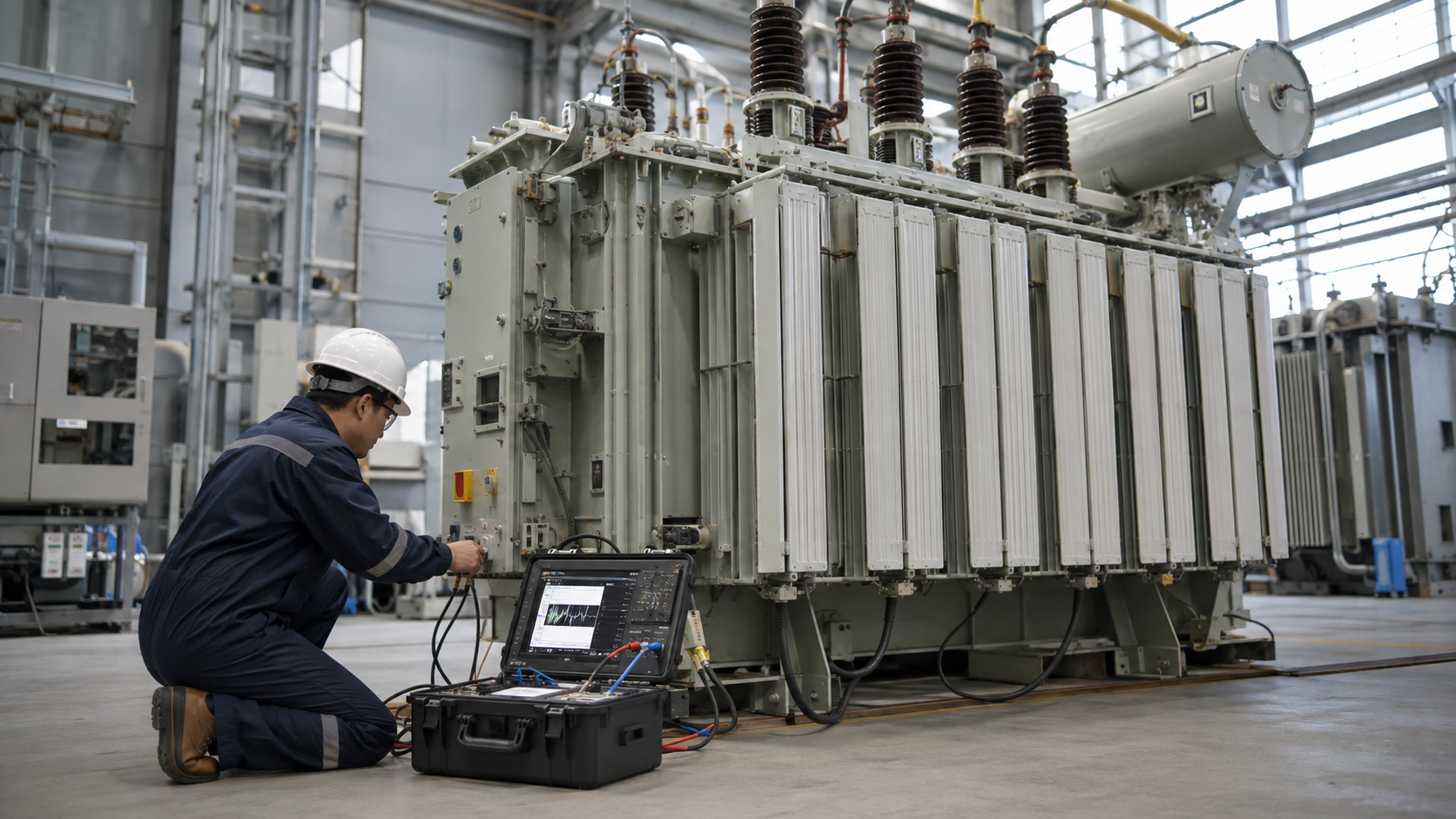

A delta-wye transformer connection uses a closed delta on one winding and a grounded or ungrounded wye on the other, creating a 30-degree phase displacement and providing a neutral when the wye point is brought out. The connection is common in three-phase distribution, but the vector group, phase sequence, grounding method, zero-sequence path and protection compensation must be specified together. A simple sketch is not enough for paralleling or relay settings.
Key Takeaways
- Line and phase voltages differ by √3 on the wye side.
- Clock notation defines whether the secondary leads or lags and is essential for paralleling.
- Grounding and zero-sequence behavior affect faults and protection.
Delta and Wye Voltage Relationships
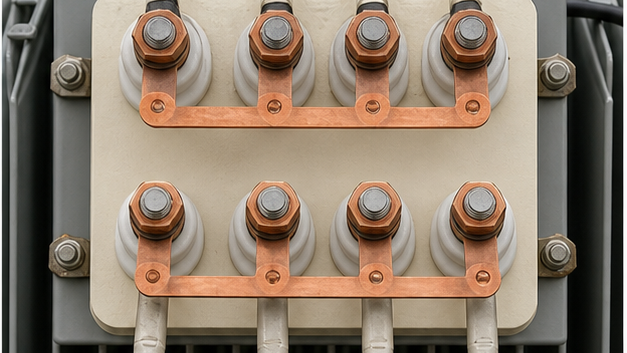
In delta, each winding phase is connected across a line-to-line voltage, so winding voltage equals line voltage. In wye, each winding phase is connected from line to neutral, so line-to-line voltage equals √3 times phase voltage. Turns ratio must therefore be compared using winding phase voltages, not by dividing two line voltages without considering the connection.
For a 480 V delta to 208Y/120 V transformer, the delta winding sees 480 V per phase and each wye winding supplies 120 V phase-to-neutral. The secondary line-to-line voltage is approximately 120 × √3 = 208 V.
Thirty-Degree Phase Shift and Vector Groups
A delta-wye bank introduces a 30-degree displacement between primary and secondary line voltages. Whether the low-voltage side leads or lags depends on terminal polarity and connection. IEC clock notation expresses this relationship, such as Dyn1 or Dyn11, together with the winding connections and accessible neutral.
Transformers intended for parallel operation need compatible ratios, polarity, phase sequence, vector group and impedance. Units with different clock numbers can create severe circulating current or a phase-to-phase short circuit when their secondaries are tied.
Neutral, Grounding and Zero-Sequence Current
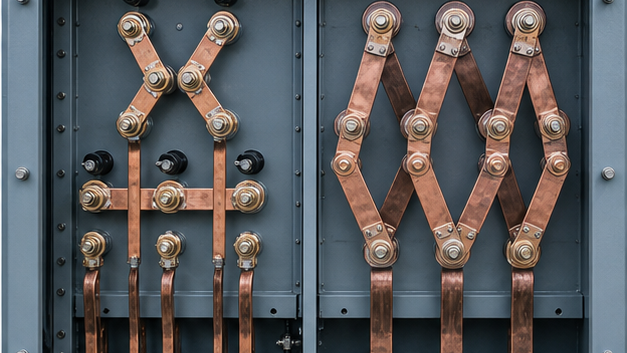
A brought-out wye neutral can supply line-to-neutral loads and can be grounded to establish a system reference. The grounding electrode, neutral conductor, bonding location and separately derived system rules must follow the applicable code and system study. Do not add an unintended second neutral-ground bond downstream.
The delta provides an internal path for triplen harmonics and some zero-sequence current while blocking zero-sequence current from passing as line current to the delta source. This behavior influences ground-fault levels and relay selection.
Delta-Wye Connection Design Checks
| Design item | Delta side | Wye side | Why it matters |
|---|---|---|---|
| Winding voltage | Equals line voltage | Equals line-to-neutral voltage | Turns ratio calculation |
| Neutral | Not available | Available if brought out | Single-phase loads and grounding |
| Phase displacement | Part of vector group | Shifted 30 degrees | Paralleling and differential protection |
| Zero sequence | Circulates internally | Depends on neutral grounding | Ground-fault current and relays |
| Typical notation | D | y or yn | Defines connection and neutral access |
Protection, Testing and Commissioning
Transformer differential relays must compensate for ratio and 30-degree phase displacement, either in CT connections or numerically. Ground-fault protection should reflect whether the wye neutral is grounded and where CTs are placed. Inrush restraint and overcurrent coordination remain necessary.
Before energization, verify nameplate vector group, terminal markings, phase rotation, ratio on every tap, winding resistance and insulation results. A phase-angle or vector-group test provides stronger evidence than continuity alone.
Engineering Validation and Safety Boundary
This guide supports specification and procurement; it does not replace a project study, the applicable code, the manufacturer instructions or work by qualified electrical personnel. Verify the following before equipment selection, testing, wiring or energization:
- Confirm terminal polarity, phase sequence and vector group from test records.
- Calculate winding voltages before selecting turns ratio or test voltage.
- Review grounding and neutral loading, including nonlinear load harmonics.
- Coordinate differential and ground-fault protection with the actual connection.
- Prohibit paralleling until ratio, angle and impedance compatibility are proven.
Information to Include in the RFQ
A useful quotation must be based on the same technical boundary for every supplier. Include the following information and require all deviations to be listed explicitly:
- Primary and secondary line voltages, kVA, frequency and tap range.
- Required vector group and whether the wye neutral is brought out.
- Grounding method, neutral current and load unbalance.
- Impedance, fault level and parallel-operation requirements.
- Terminal diagram, phase-angle test report and protection interface data.
From Technical Data to an Approved Decision
Use a staged review rather than approving the first catalogue match. Begin with delta and wye voltage relationships, then reconcile thirty-degree phase shift and vector groups with neutral, grounding and zero-sequence current. Complete the review with protection, testing and commissioning. At each stage, record the source document, units, operating case and person responsible for approval. This prevents a value copied from an old drawing, nominal system label or unrelated product from becoming an uncontrolled design input.
Before acceptance, compare the supplier response line by line with the RFQ and mark every exception. Confirm that drawings, calculations, settings, certificates and test reports refer to the exact offered model and revision. Preserve the approved submittal, nameplate data, factory results and commissioning measurements as the maintenance baseline. If a rating, connection, environment or test condition changes, repeat the affected review rather than assuming the original conclusion remains valid.
Document control should identify revision, approval status and superseded files. Field teams should receive the same approved values used for procurement, while commissioning records should capture any authorized change made during installation. This traceability is especially important when equipment is replaced years later: the next engineer needs verified interfaces and test history, not an incomplete description copied from a purchase order.
Coverage Informed by Current Search Results
The current U.S. Google top-20 review repeatedly surfaced themes including Wye (Y) Connection, Delta (Δ) Connection, Wye-Wye (Y-Y), I have two Delta Wye transformers installed in a main-tie-main. One failed, can I replace the failed one with a Wye Wye?, What Are the Differences Between Delta and WYE Systems?. The article addresses those user needs in an original engineering and procurement sequence; competitor brand navigation and unrelated sales material were excluded.
Related LBAJI Resources
Continue with transformer voltage and vector-group guide transformer wiring diagram guide three-phase transformer products. These resources help connect the calculation or component decision to a complete transformer, switchgear, control or distribution specification.
Technical References and Further Reading
- IEC 60076-1 Power Transformers — Connection symbols and transformer requirements.
- IEEE Standards Association transformer standards — Transformer connection, testing and protection standards.
- NFPA codes and standards — Electrical grounding and installation requirements.
Conclusion
A delta-wye connection should be specified by vector group, not merely by the words delta and wye. Correct phase-angle, neutral grounding, zero-sequence and protection decisions are required before wiring, testing or paralleling.