
A 500 kVA distribution transformer is rated to transfer 500 kilovolt-amperes of apparent power under its specified operating conditions. For a balanced three-phase 400 V secondary, calculated full-load line current is about 721.7 A; at 480 V it is about 601.4 A. At 0.8 load power factor, 500 kVA corresponds to 400 kW of real load, not 500 kW. A useful purchase decision needs more than the capacity number: primary and secondary voltage, phase, winding connection, losses, impedance, dimensions, installation conditions and required tests must all match the project. The figures below combine standard formulas with the published data of one LBAJI 500 kVA model; they do not describe every transformer of this rating.
What Does a 500 kVA Distribution Transformer Do?
A distribution transformer changes one AC voltage to another for a distribution network. In a common step-down application, the primary connects to a medium-voltage feeder and the secondary supplies a lower-voltage distribution board. “500 kVA” names its apparent-power rating. It does not alone identify the voltage ratio, number of phases, cooling system or outdoor enclosure. The exact nameplate and connection drawing are essential because two units with the same kVA can be electrically incompatible.
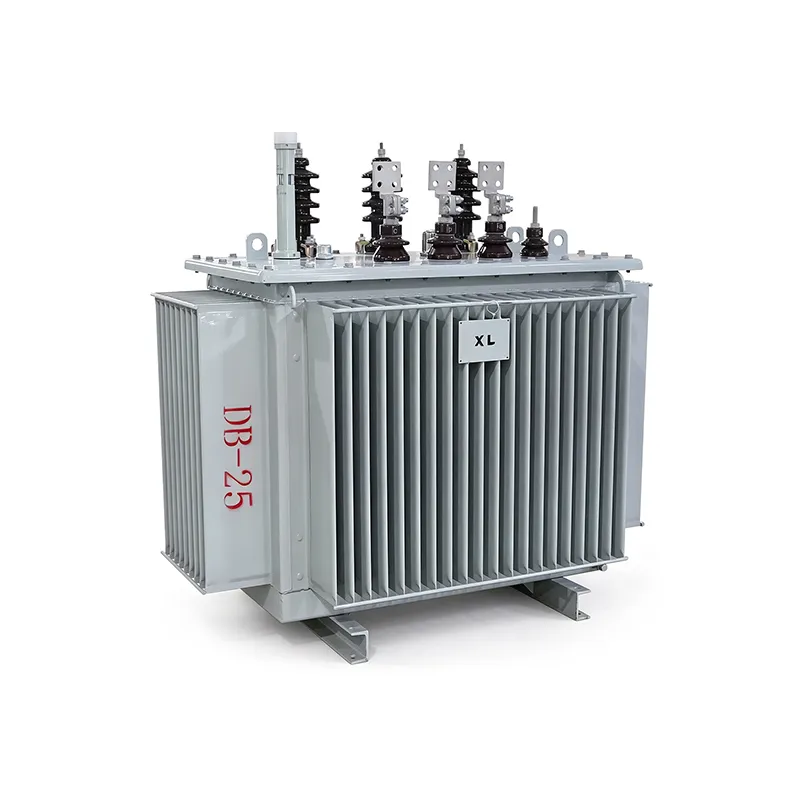
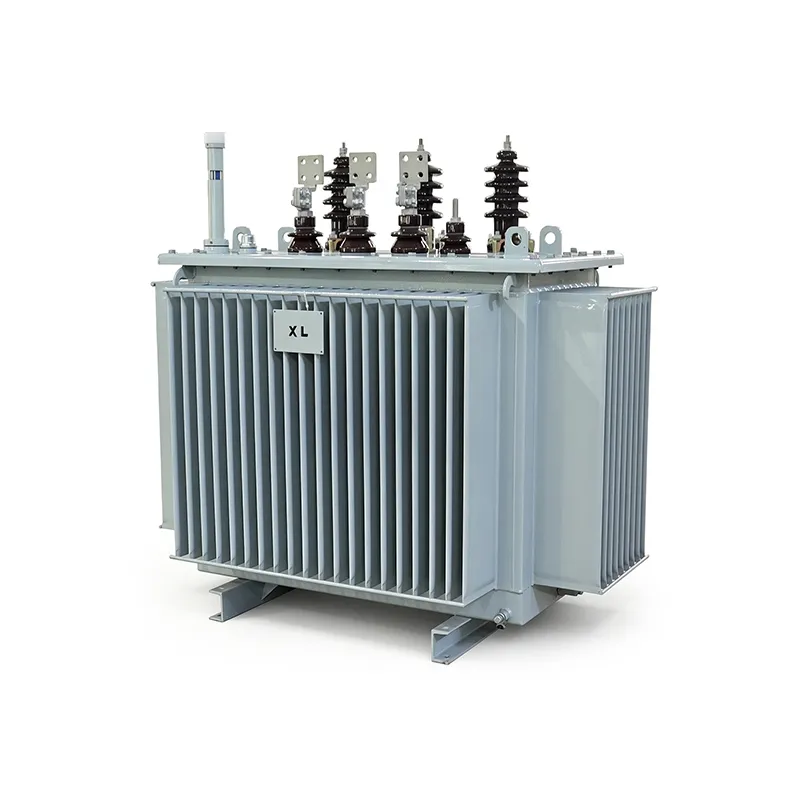
One actual product on this site is the S11-M-500-10 oil-immersed power transformer. Its published series table includes a 500 kVA row and a family of high-voltage options. Those options are not a statement that every combination is available for immediate delivery. Confirm the offered nameplate voltage, winding connection, tap setting and approved drawing in the quotation.
500 kVA Full-Load Current and kW
For a balanced three-phase transformer, line current is I = 500,000 ÷ (√3 × line-to-line voltage). For single phase it is I = 500,000 ÷ winding voltage. These are apparent-power relationships, not breaker settings. Schneider Electric’s transformer calculation guidance gives the inverse kVA formulas. Use only the voltage and phase that appear on the selected nameplate.
| Three-phase winding voltage | Calculated full-load line current | Use case for comparison |
|---|---|---|
| 400 V | 721.7 A | Common low-voltage secondary example |
| 415 V | 695.6 A | Alternative low-voltage system example |
| 480 V | 601.4 A | Alternative low-voltage system example |
| 10 kV | 28.9 A | Medium-voltage primary calculation example |
For a 10 kV to 0.4 kV three-phase step-down unit, the calculated full-load primary line current is about 28.9 A and the 400 V secondary line current is about 721.7 A. The transformer changes the voltage-current relationship while transferring approximately the same apparent power, apart from losses. At 0.8 power factor, a 500 kVA apparent load represents 400 kW of real load; at 0.9, it represents 450 kW. Neither conversion means the equipment can safely feed every 400 or 450 kW load: harmonics, motor starts, ambient temperature and voltage regulation still need review.
Published Specifications for One 500 kVA Model
The table below extracts only the 500 kVA row from LBAJI’s published S11-M-500-10 product schedule. It is a reference for an inquiry, not a guaranteed final datasheet. The product schedule states different load-loss values for different vector groups, so a buyer should confirm which figure applies to the quoted winding connection.
| Published item | 500 kVA row | What to confirm |
|---|---|---|
| Rated capacity | 500 kVA | Continuous rating and operating conditions |
| Listed high-voltage family / low voltage | 6, 6.3, 10, 10.5 or 11 kV / 0.4 kV | The exact offered voltage pair and taps |
| No-load loss | 680 W | Guaranteed value and test basis |
| Load loss | 5,410 / 5,100 W | Which vector-group value applies |
| Short-circuit impedance | 4.0% in the series table | Quoted tolerance and system coordination |
| Published outline / mass | 1,450 × 950 × 1,300 mm / 1,590 kg | Final approved drawing and shipping mass |
Notice that the product page is a family table covering many ratings, even though its title names 500 kVA. The published row helps create a precise question list, but it is not evidence that every accessory, tap arrangement or delivery configuration is standard. Request the signed technical schedule and factory test documentation for the specific project.
Losses and Efficiency: Compare the Right Numbers
No-load loss occurs while the transformer is energized, even if the downstream load is small. Load loss rises as current rises. The U.S. Department of Energy’s distribution-transformer rule describes these two loss components and notes that load loss grows roughly with the square of the per-unit load. Therefore a quote should separate no-load loss, rated load loss, test conditions and expected loading profile. Calling a transformer “efficient” without these figures does not allow a meaningful comparison.
For example, a 500 kVA unit carrying 250 kVA is at 50% apparent-power load. Under the simplified relationship, the load-loss component at that point is approximately one-quarter of its rated-load value, while no-load loss remains present whenever energized. Actual loss evaluation must use the guaranteed test values and correction method for the chosen unit. It should not simply add the nameplate losses and declare a universal annual energy cost. The ENERGY STAR distribution-transformer buyer guide explains why load profile matters in total owning cost.
Is 500 kVA Enough for Your Load?
Prepare a demand schedule with each load’s voltage, phase, running kW or kVA, power factor, starting method and expected coincidence. Convert kW to apparent power using kVA = kW ÷ power factor when the load’s power factor is known. If simultaneous loads are 300 kW at 0.9 power factor, their apparent demand is about 333 kVA before other loads or starting conditions. If they are 420 kW at 0.8 power factor, the result is 525 kVA, already above a 500 kVA nameplate. These examples are arithmetic screens, not complete system studies.
Check motor starting and voltage dip separately; a motor’s running demand can understate its start-up impact. Review nonlinear loads, planned expansion, altitude, ambient temperature, enclosure ventilation and the operator’s loading policy. Do not treat 500 kVA as a fixed 400 kW limit just because 0.8 power factor is a convenient example. Nor should “overload capacity” be promised without a specific manufacturer loading guide and temperature assessment.
For broader comparison, use the standard transformer sizes guide, the transformer capacity guide and the amps-to-kVA formula guide. These address different questions: available rating steps, selecting a required capacity, and converting measured current.
Oil-Immersed, Dry-Type or Pad-Mounted?
“500 kVA” describes capacity, while oil-immersed and dry-type describe construction. “Pad-mounted” describes an outdoor enclosure and installation arrangement. A 500 kVA oil-immersed unit is not automatically a pad-mounted unit, and a bare transformer should not be represented as a complete tamper-resistant pad-mounted assembly. For each option, compare the actual installation site, cooling, fire and environmental requirements, enclosure, cable entry, protection and maintenance arrangements.
Ask whether the quoted unit includes the transformer only or an integrated enclosure, medium-voltage switching and low-voltage compartment. The site product linked above is an oil-immersed transformer family; its published row does not by itself establish a pad-mounted enclosure. If a project requires an integrated substation, that is a separate scope. The 35 kV oil-immersed product page shows another family and illustrates why voltage class and construction must be stated explicitly.
Protection, Testing and Procurement Checklist
The calculated 721.7 A at 400 V is not an instruction to install a breaker of that exact rating. Protection requires evaluation of transformer inrush, short-circuit duty, primary and secondary arrangements, conductor ampacity and local electrical rules. Confirm the selected impedance with the system fault and voltage-drop study. Grounding and winding connection also affect downstream protection. A qualified electrical designer should coordinate the transformer with the upstream feeder and low-voltage board.
Before placing an order, request the following: rated kVA and duty, exact primary and secondary voltages, frequency, phase, vector group, tapping range, cooling and installation conditions, no-load and load losses, impedance, temperature rise, oil and insulation details, accessories, dimensions, mass, applicable standards, routine tests and the approved connection/outline drawings. IEC 60076-1 addresses general power-transformer ratings, connection symbols, nameplate information and tests; the contract must identify the specific standard edition and any additional utility or national requirements.
For a replacement, also give the supplier the existing unit’s full nameplate and site photographs, not just “500 kVA.” Check lifting access, foundation, cable termination heights and outage constraints. For a new project, compare technical offers on the same basis before comparing prices. A lower price paired with a different voltage, loss basis, enclosure or test scope is not an equivalent offer.
Three-Phase Transformer Video Lesson
NPTEL’s university lecture gives background on three-phase transformer connections. The current table and buyer checklist above provide the direct 500 kVA information; the video is optional further study.
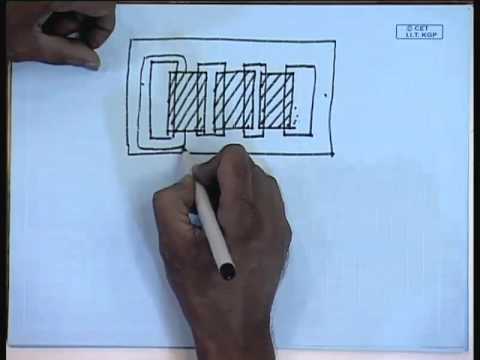
Watch NPTEL’s Introduction to Three Phase Transformer on YouTube.
Frequently Asked Questions
How many amps is a 500 kVA transformer?
It depends on voltage and phase. At 400 V three phase, full-load line current is about 721.7 A; at 480 V three phase, about 601.4 A. The primary current is different again.
How many kW is 500 kVA?
At 0.8 load power factor, it corresponds to 400 kW; at 0.9, to 450 kW. These are real-power conversions, not universal operating limits.
Is a 500 kVA transformer always pad-mounted?
No. Pad mounting is an enclosure and installation arrangement. Confirm the offered construction and complete scope rather than inferring it from kVA.
What is the size of a 500 kVA transformer?
There is no universal dimension. One LBAJI series table lists 1,450 × 950 × 1,300 mm and 1,590 kg for its 500 kVA row; the ordered unit requires an approved outline drawing.