
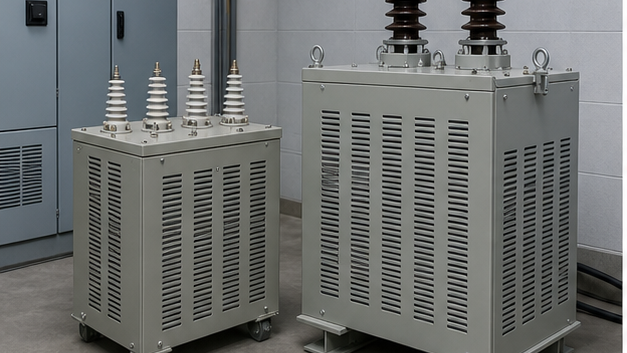
An isolation transformer transfers AC power through magnetic coupling between electrically separate primary and secondary windings. Its purpose is galvanic separation: there is no intended conductive connection through the windings from the source circuit to the load circuit. Many isolation transformers have a 1:1 voltage ratio, but separation and voltage conversion are independent design choices. An isolated secondary can still deliver hazardous voltage and current. The correct selection therefore depends on the intended grounding arrangement, load, insulation rating and application—not simply the word “isolation” on a label.
How the separate windings transfer power
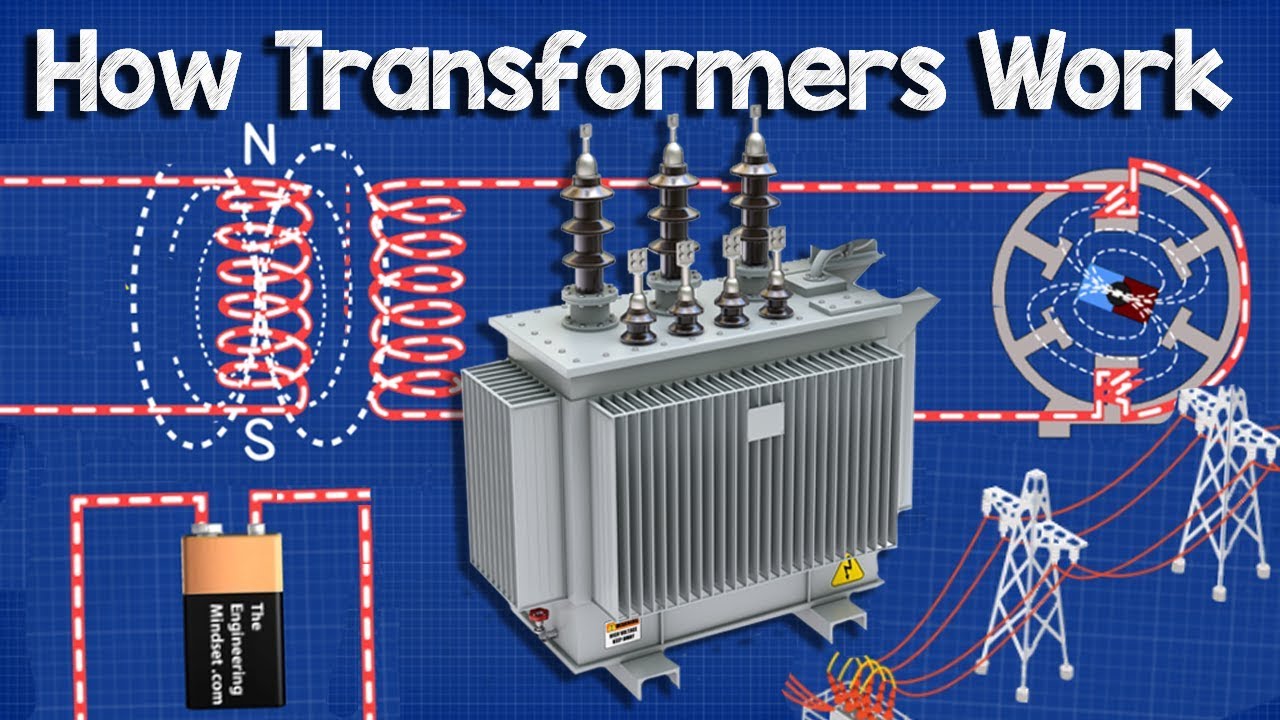
Alternating current in the primary establishes changing magnetic flux in the core. That changing flux induces voltage in the secondary. The secondary circuit obtains energy through the magnetic field rather than through a conductor joining the windings. Insulation separates the circuits while the core provides the magnetic path. The winding construction and insulation system must suit their working voltages and the specified dielectric stresses.
In an ideal transformer, secondary-to-primary voltage ratio equals secondary-to-primary turns ratio. Equal turns produce approximately equal voltages; unequal turns can step voltage up or down while the windings remain electrically separate. Real output also depends on loading, winding drop and supply variation. The OpenStax treatment of transformer operation explains this magnetic coupling and ratio relationship.
Isolation, voltage reduction and regulation are different
A 230-to-230 V isolation transformer provides separation without intentionally reducing nominal voltage. A 230-to-24 V separate-winding transformer can provide both voltage reduction and separation, subject to its designed insulation and application. A variable autotransformer may change voltage while providing neither of those separate-winding benefits. Read the actual construction and specification rather than assuming that lower output means isolation.
Voltage regulation is a further distinction. An ordinary isolation transformer does not hold the output perfectly constant as supply or load changes. It is also not an uninterruptible power supply: output disappears when the source disappears unless another system supplies energy. These distinctions prevent a transformer from being purchased to solve a power-quality or continuity problem it cannot address.
| Equipment | Main function | Important limitation |
|---|---|---|
| 1:1 isolation transformer | Separate source and load circuits at similar nominal voltage | Secondary voltage remains potentially hazardous |
| Separate-winding step-down transformer | Reduce voltage and separate windings | Suitability for protective separation depends on the actual design |
| Autotransformer | Change voltage through a shared winding | Provides a conductive source-to-load path |
| Voltage regulator | Control output-voltage variation | Does not necessarily provide galvanic isolation |
| UPS | Support continuity and specified power conditioning | Isolation depends on the particular UPS architecture |
What electrical isolation does for safety
Separating the source and secondary circuits changes the possible current paths relative to earth. In a deliberately unearthed secondary arrangement, touching one conductor and earth is different from making the same contact on a grounded supply. That observation is the basis of some protective-separation arrangements, but it is not a general permission to touch the secondary. Capacitive coupling, leakage, connected equipment and faults can change the situation.
Touching both secondary conductors can complete a hazardous circuit regardless of separation from the source. Connecting additional equipment may introduce an earth reference. A single fault can alter conditions for a subsequent contact. The OpenStax discussion of electrical safety systems explains the relationship between isolation and current paths. Actual protective measures must be designed for the application and local installation rules.
Grounding and bonding must match the application
An industrial isolation transformer may intentionally establish a grounded secondary system, with its neutral and bonding arrangement designed as part of the installation. A specialized test arrangement may instead require a deliberately unearthed secondary under controlled conditions. These are different systems. Neither can be selected correctly by following a rule that every isolation-transformer secondary must always float or must always be bonded.
The enclosure and exposed conductive parts still require the protective arrangements specified for the equipment. Removing a protective-earth conductor to “improve isolation” can make accessible metal dangerous. Likewise, adding a neutral-to-earth bond without reviewing the circuit can defeat the intended arrangement or create unwanted current paths. The connection drawing should identify the secondary reference, enclosure bonding and associated protective devices explicitly.
Noise reduction and electrostatic shields
Electrical separation can interrupt a direct common-mode conductive path, but a real transformer also has capacitance between windings and to its surroundings. High-frequency disturbances can couple through that capacitance. An electrostatic shield between windings can divert some capacitive current to its designated reference when connected as designed. Shield performance depends on frequency, construction and installation; it is not a promise to remove every disturbance.
Distinguish common-mode noise from differential-mode disturbances between supply conductors. An isolation transformer may help one path while leaving another substantially unchanged. It cannot be assumed to eliminate harmonic current drawn by nonlinear loads or correct a source frequency problem. Before buying, identify the disturbance, how it is measured and the required attenuation or performance. A general “clean power” claim is not enough to select the equipment.
Where isolation transformers are used
Industrial controls may use separate windings to establish a suitable control supply and reference. Test facilities may need separation for a defined measurement arrangement. Sensitive equipment may benefit from a carefully engineered grounding and shielding strategy. Marine, medical and other specialized systems may also use isolation, but their complete installation requirements differ. A general industrial transformer is not automatically suitable for every specialized environment.
Medical isolated-power systems, for example, involve application-specific equipment and monitoring requirements. A transformer alone does not create a compliant medical system. Similarly, a bench isolation arrangement must account for every connected instrument. An earthed oscilloscope lead or other connection can introduce a reference that changes the test circuit. Qualified personnel should review the whole setup rather than treating the transformer as an isolated accessory.
Sizing example: a 230 V load
Suppose a single-phase load draws 4 A at 230 V under its specified operating condition. Apparent power is 230 × 4 = 920 VA. A transformer must accommodate that demand along with applicable duty, temperature and startup requirements. If the load is described only as 700 W, its VA cannot be established without power factor or input-current information. Choosing a 700 VA unit from watts alone can understate the required rating.
This example does not prescribe a standard oversizing percentage. A contactor load, motor, rectifier or electronic power supply can have startup or waveform demands that change selection. Ask for maximum operating VA, inrush and duration, permissible voltage drop and duty cycle. Cooling and enclosure conditions matter too: a transformer rated for a specified ambient and ventilation arrangement may need a different installation or rating in a hot cabinet.
What to compare on two quotations
Compare primary and secondary voltage ranges, phase, frequency, continuous VA, insulation arrangement, dielectric test basis, temperature rise, cooling, enclosure and terminal access. Identify any electrostatic shield and its designated connection. Require no-load and load-loss information where energy use matters. If the objective is noise reduction, request performance data relevant to the measured disturbance rather than relying on the presence of a shield alone.
Mechanical details also affect whether the proposal works: mass, mounting, clearances, heat dissipation, sound and maintenance access. Ask who supplies overcurrent protection and how it coordinates with inrush and downstream faults. Include the intended secondary grounding system and confirm that the proposed device supports it. These details are especially important when replacing an existing installation whose original design documents are incomplete.
Inspection and commissioning
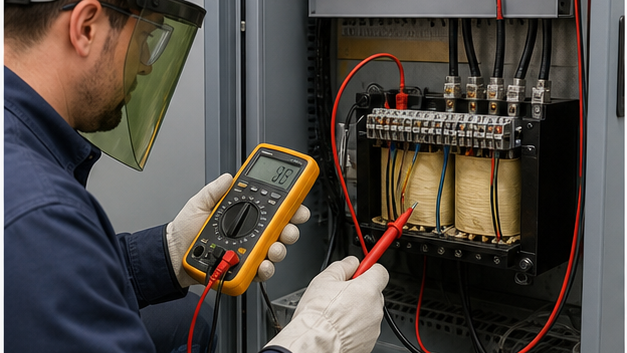
Before energization, verify identification, physical condition, insulation and connection arrangements according to the approved test plan. Check that temporary shipping or test connections have been removed, and confirm enclosure bonding and the specified secondary reference. Ratio and insulation tests answer different questions. A handheld meter showing no continuity between windings does not prove that insulation meets its operating or dielectric-test requirements.
During controlled commissioning, confirm input and output voltage, load current and expected temperature behavior. Investigate abnormal sound, odor, heating or protective-device operation. Keep the final drawings and test results with the asset record. OSHA electrical installation requirements provide relevant context for equipment suitability and installation in accordance with instructions; the approved project design governs the actual connection.
Common specification mistakes
The most frequent misunderstandings are assuming every 1:1 transformer is suitable for protective separation, treating an autotransformer as isolated, selecting VA from watts alone, removing earth connections, and expecting the transformer to solve every noise problem. Each mistake comes from asking one component to establish a property of the complete electrical system. Write the intended result explicitly: separation, voltage conversion, a new reference, noise attenuation or continuity of power.
Once that result is clear, the remaining decisions become easier to verify. An isolation transformer can be a useful part of a properly designed power system, but its value comes from correct selection and integration. Retain the grounding diagram, load requirements and acceptance evidence so later equipment changes do not unintentionally alter the arrangement.
Related transformer guides and product context
Review the transformer fundamentals guide for the underlying principles. For adjacent questions, read What Is an Autotransformer? Principle, Uses and Limits and What Does a Step-Down Transformer Do? Operation and Uses. For distribution-equipment specifications, see the 35 kV oil-immersed power transformer; confirm the actual product scope and ratings before using it in a project.
Video: the underlying transformer principle
The Engineering Mindset illustrates the electrical principle discussed here. This background explanation complements the article; it does not demonstrate or authorize field work.
Frequently asked questions
What is an isolating transformer?
It transfers AC power between electrically separate windings through magnetic coupling. It may maintain, reduce or increase voltage depending on turns ratio.
Is the output safe to touch?
No. Contact between secondary conductors can complete a hazardous circuit, and grounding or connected equipment changes other current paths. Isolation is part of a designed protective arrangement.
Must an isolation-transformer secondary float?
Not universally. Some applications use an unearthed arrangement; others establish an intentionally grounded secondary. Follow the approved system design and applicable rules.
Will it remove all electrical noise?
No. Performance depends on disturbance mode, frequency, winding capacitance, shielding and installation. Request relevant measured performance for the actual problem.
Can it replace a UPS?
No. A transformer does not store the energy needed to maintain output during a supply interruption. Continuity requires a suitable separate power system.