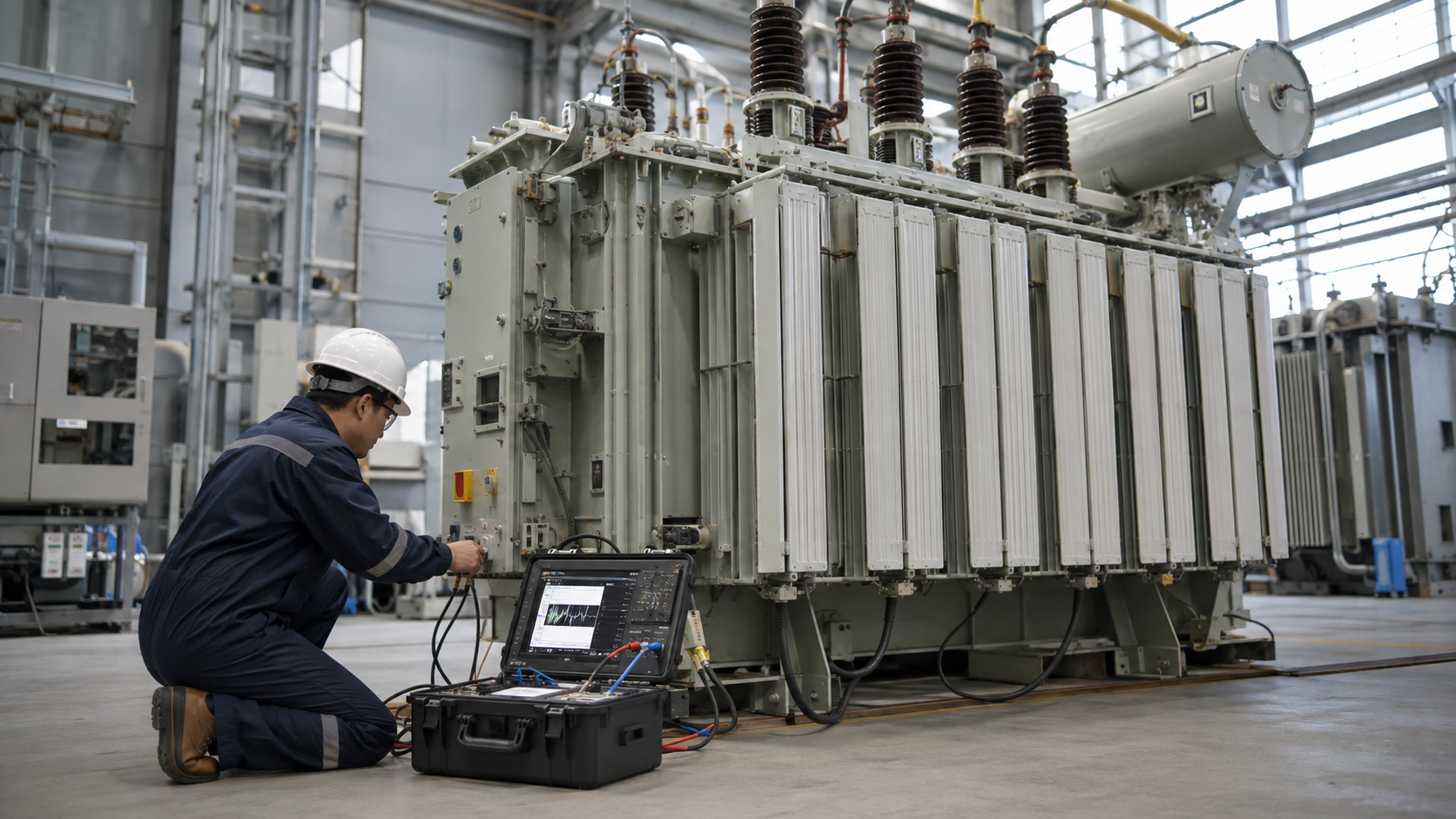

A transformer transfers electrical energy between circuits through electromagnetic induction. Its practical job is to change voltage and current to levels that make power generation, transmission, distribution, and final use safe and efficient. Understanding the relationship between transformers and power systems helps engineers select the right voltage ratio, capacity, insulation, and protection. This guide explains what electrical transformers do, how they work, the main transformer types, and the information buyers should define before selecting equipment for a real project.
For industrial and utility projects, “transformer” can mean anything from a small control transformer to a multi-megavolt-ampere substation unit. The same physical principle applies, but the construction, insulation, cooling method, protection scheme, installation environment, and procurement requirements can be very different.
What Does a Transformer Do?
A transformer changes alternating-current voltage while keeping the supply frequency essentially unchanged. In an ideal transformer, power entering the primary winding equals power leaving the secondary winding. A real transformer has losses, so output power is slightly lower than input power.
The relationship between voltage and turns is commonly expressed as:
V1 / V2 = N1 / N2
Here, V is voltage and N is the number of turns in each winding. If the secondary has more turns than the primary, the unit is a step-up transformer. If it has fewer turns, it is a step-down transformer.
Current changes in the opposite direction. When voltage is stepped up, current is stepped down for approximately the same power level. This is why high voltage is used for long-distance transmission: lower current reduces conductor losses. Near the load, distribution transformers reduce voltage to the level required by factories, commercial buildings, renewable-energy plants, and local distribution networks.
How an Electrical Transformer Works
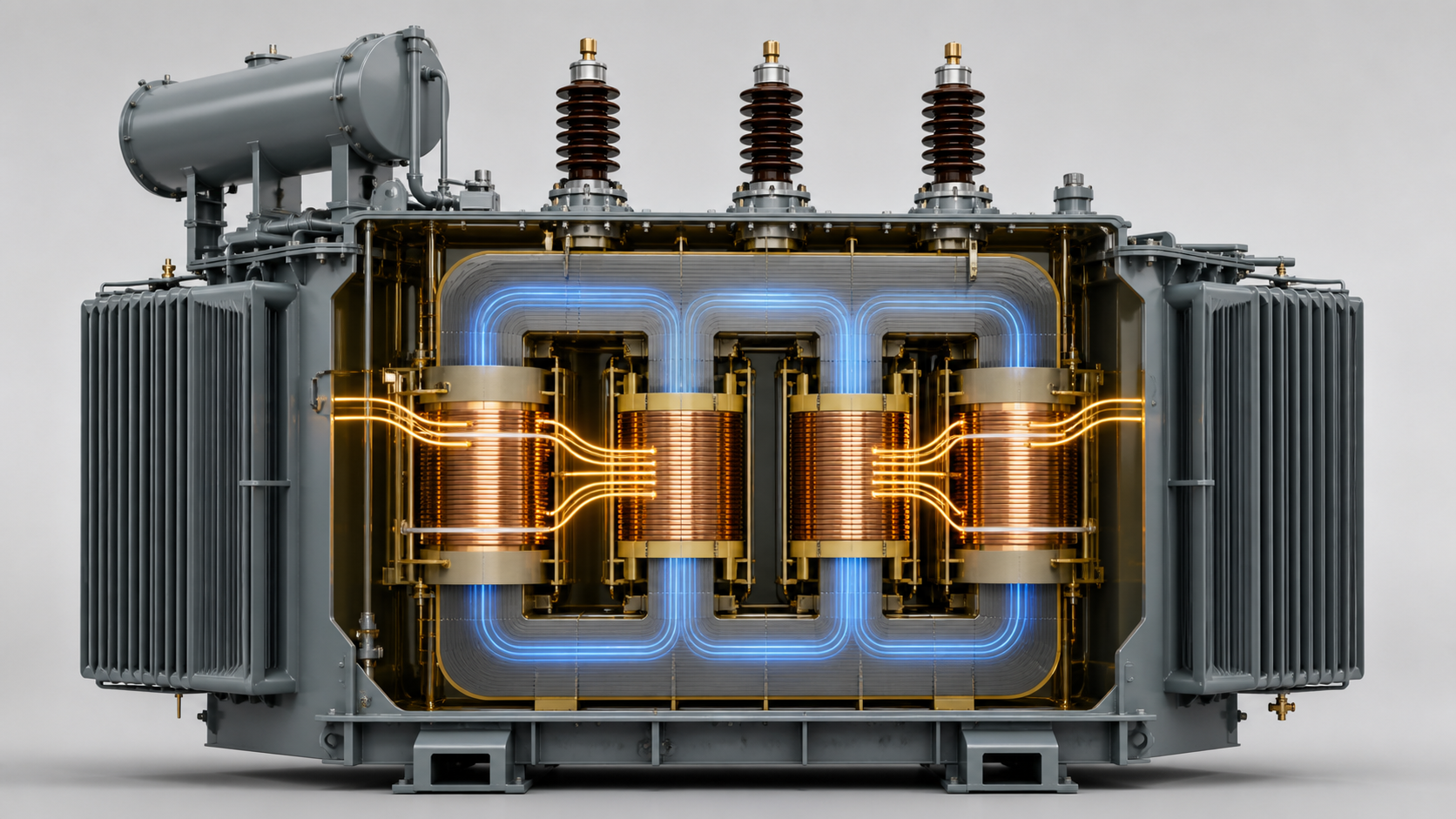
An AC voltage applied to the primary winding produces an alternating magnetic flux in the laminated or wound core. That changing flux links the secondary winding and induces a voltage. The two windings are electrically separated in most designs, but they are magnetically coupled through the core.
The core provides a controlled path for magnetic flux. Grain-oriented electrical steel is widely used because it reduces hysteresis and eddy-current losses. Winding conductors are normally copper or aluminum. Insulation between turns, windings, core, and tank must withstand operating voltage, switching stress, temperature, and the expected service environment.
A transformer requires changing magnetic flux, so a conventional power transformer does not operate from steady DC. Applying DC to an AC transformer can cause excessive current, overheating, and damage. Electronic DC converters may use high-frequency transformers internally, but they first switch the DC into a changing waveform.
Core Transformer Ratings Buyers Should Understand
kVA or MVA
Transformer capacity is rated in volt-amperes rather than watts because heating depends on voltage and current, while the connected load determines power factor. A 1,000 kVA transformer does not automatically supply 1,000 kW. At a 0.90 power factor, the corresponding real-power load is approximately 900 kW before other design margins are considered.
Primary and secondary voltage
Both the nominal system voltage and the required equipment voltage class matter. A request such as “a 35 kV transformer” is incomplete without the low-voltage output, system frequency, insulation level, grounding method, and connection arrangement.
Single-phase and three-phase
Single-phase transformers are common for smaller loads and some utility distribution applications. A three-phase transformer serves three-phase power systems in factories, substations, data centers, renewable-energy facilities, and commercial infrastructure. Three single-phase units can also form a bank, but a purpose-built three-phase transformer usually provides a more compact installation.
Frequency
A transformer must be designed for the specified frequency, commonly 50 Hz or 60 Hz. Operating a unit at a lower frequency without reducing voltage can increase core flux and overheating risk.
Impedance
Percentage impedance affects voltage drop, fault current, and parallel operation. It is not simply a lower-is-better figure. The correct value depends on the system short-circuit study, protection coordination, load behavior, and equipment connected downstream.
Vector group
The vector group describes winding connection and phase displacement. Common choices include Dyn11, Yyn0, and YNd arrangements, but the correct selection must match system grounding, harmonic behavior, protection, and any transformers intended to operate in parallel.
Main Types of Power Transformers
Power transformers
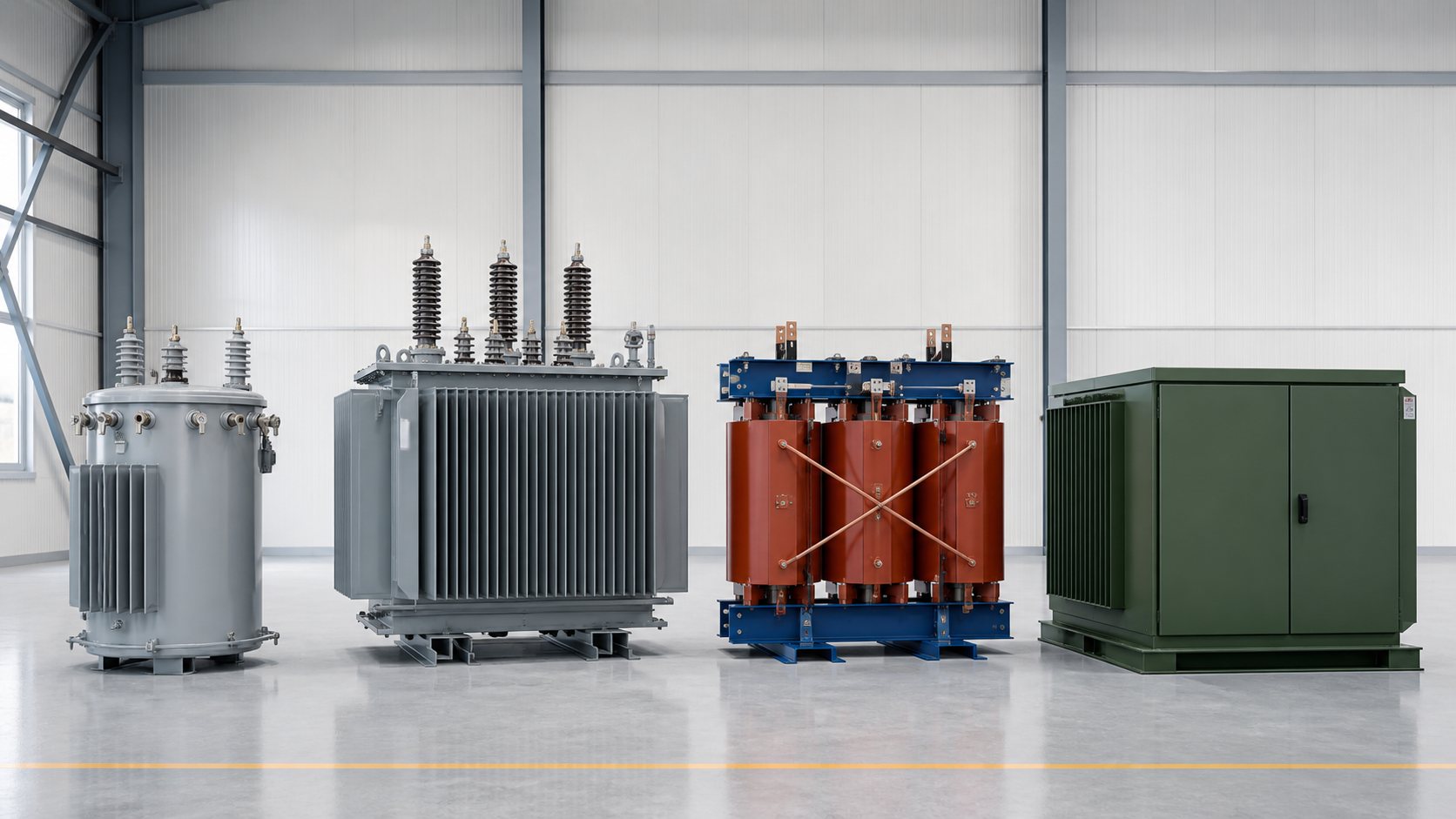
Power transformers are generally used at generation and transmission levels or for large industrial loads. They are designed around high voltage, high capacity, system reliability, efficiency, and the expected load profile. LBAJI supplies configurations such as the 35 kV oil-immersed power transformer and the SFZ11 35 kV on-load tap-changing transformer for projects requiring voltage transformation and regulation.
Distribution transformers
A distribution transformer supplies end users at the final stages of the power system. Because many distribution units remain energized continuously, no-load loss can be as important as full-load efficiency. Capacity, daily load curve, overload expectation, harmonics, ambient temperature, noise limits, and future expansion should be reviewed together.
Oil-immersed transformers
In an oil-immersed transformer, insulating liquid provides both electrical insulation and heat transfer. These units are widely used outdoors and in substations because they offer strong cooling performance and broad capacity options. The tank may be hermetically sealed or use a conservator system, depending on design and project requirements.
Oil-filled equipment requires site planning for fire safety, oil containment, ventilation, access, and environmental conditions. LBAJI’s S-M oil-immersed transformer series is relevant to general distribution applications, while larger 35 kV designs suit utility and industrial substations.
Dry-type transformers
Dry-type transformers use solid insulation and air for cooling instead of insulating oil. They are frequently selected for indoor installations, commercial buildings, factories, hospitals, transport facilities, and other sites where fire behavior and maintenance planning favor oil-free equipment. For a project-level comparison, see our guide to dry-type vs oil-immersed transformers.
Dry-type does not mean maintenance-free or suitable for every environment. Enclosure protection, ventilation, dust, humidity, condensation, altitude, temperature rise, and sound level remain important. For a separate discussion of the term “dry-type triplex,” confirm the actual winding arrangement and supplier drawings rather than inferring construction from the label; see our dry-type triplex transformer guide. LBAJI offers the SC(B) resin-insulated dry transformer series and the SG(B) environment-friendly dry-type transformer for indoor distribution requirements.
Step-up and step-down transformers
A step-up transformer raises voltage, such as between a generator or renewable-energy inverter system and a medium-voltage network. A step-down transformer reduces voltage for distribution and utilization. The same transformer can behave as step-up or step-down depending on which winding is energized, but safe reverse operation is not automatic. Taps, grounding, insulation coordination, protection, inrush current, and manufacturer approval must be checked.
Isolation transformers
An isolation transformer commonly has a 1:1 voltage ratio and separates the source circuit from the load. It can support safety, noise control, and grounding objectives. It does not eliminate every shock hazard, and its secondary grounding arrangement must be engineered for the application.
Autotransformers and buck-boost transformers
An autotransformer uses a shared winding, which can reduce size, material, and cost when the voltage ratio is relatively small. The tradeoff is that it does not provide the same galvanic isolation as a two-winding transformer. Buck-boost transformers make modest voltage corrections and are useful when equipment voltage differs slightly from the available supply. For the correction-kVA calculation and selection limits, see our buck-boost transformer guide.
Pad-mounted and pole-mounted transformers
A pad-mounted transformer is installed at ground level in a locked, tamper-resistant enclosure and is commonly used with underground distribution systems. A pole-mounted transformer is installed overhead on a utility pole, typically for local distribution. Selection depends on network design, rating, access, public safety, cable arrangement, environment, and utility practice.
Instrument transformers
Current transformers (CTs) and voltage or potential transformers (VTs/PTs) reduce system current or voltage to measurable values for meters and protective relays. They are not load-supply transformers. CT secondary circuits must never be left open while the primary carries current because dangerous voltage can develop. For residual or earth-fault detection with all live conductors passing through one core, see our core balance current transformer guide.
Three-dimensional wound-core transformers
A three-dimensional wound-core design uses a symmetrical magnetic circuit intended to reduce magnetic path differences and support low-loss, low-noise performance. The LBAJI S-M-L three-dimensional delta transformer is an option for buyers comparing lifecycle energy performance and acoustic requirements with conventional stacked-core designs.
Transformer Cooling Methods
Cooling design determines how heat moves from windings and core to the surrounding environment. Common oil-immersed designations include ONAN, where oil and air circulate naturally, and ONAF, where fans increase heat rejection. Larger units may use forced oil circulation and dedicated heat exchangers.
Dry-type transformers commonly use natural air cooling or forced-air fans. Fans can provide additional capacity in designs rated for that operating mode, but they also add maintenance items and do not correct inadequate room ventilation.
Transformer Losses and Efficiency
No-load loss occurs in the core whenever the transformer is energized. Load loss is mainly produced by winding resistance and stray effects and rises with current. The lowest purchase price may not produce the lowest lifetime cost, especially for continuously energized distribution transformers.
Buyers should compare guaranteed losses at the specified reference conditions, not only a headline efficiency percentage. Evaluation should consider the expected load profile, energy price, service life, temperature, applicable efficiency standard, and capitalization method.
Protection and Safe Operation
Transformer protection is a system, not a single accessory. Depending on rating and application, it may include fuses, circuit breakers, overcurrent and earth-fault relays, differential protection, temperature devices, pressure relief, gas-actuated protection, liquid-level indication, surge arresters, and fire-detection measures.
Grounding and bonding must follow the system design and local regulations. Primary and secondary protection must coordinate with transformer inrush current and downstream faults. Installation, testing, energization, and maintenance should be performed by qualified electrical personnel under approved procedures.
How to Select a Transformer for a Project
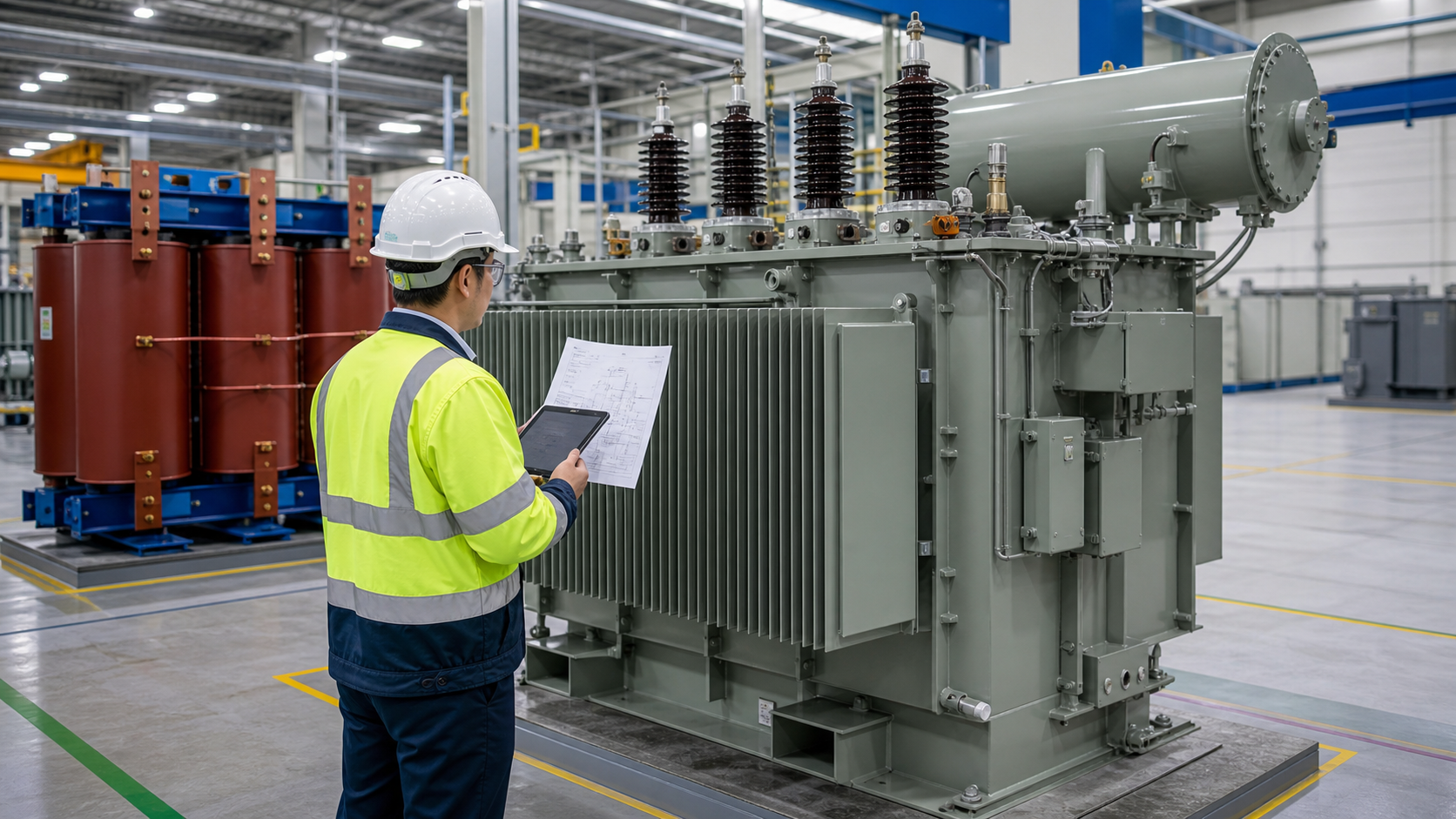
- Define the electrical system: primary voltage, secondary voltage, phases, frequency, grounding, short-circuit level, and vector group.
- Calculate the load: connected kVA, demand factor, power factor, motor starting, nonlinear loads, load cycle, redundancy, and planned expansion. Use a documented transformer kVA sizing calculation rather than selecting capacity from connected load alone.
- Define the installation: indoor or outdoor location, ambient temperature, altitude, humidity, pollution, seismic conditions, enclosure rating, cooling air, noise, and footprint.
- Choose insulation and cooling: oil-immersed or dry-type, insulation class, temperature rise, cooling method, and fire or environmental requirements.
- Specify performance: impedance, guaranteed losses, efficiency standard, sound level, voltage regulation, overload duty, and tap range. Review transformer impedance and short-circuit requirements with the system protection study.
- Specify interfaces: cable or busbar connections, terminal orientation, neutral arrangement, accessories, control voltage, communication, and monitoring.
- Define verification: applicable IEC, IEEE, or local standards; routine, type, and special tests; drawings; certificates; inspection; and factory acceptance requirements.
For packaged distribution projects, a transformer may also be integrated with medium-voltage and low-voltage equipment. LBAJI’s YB27-12 modular box substation and YBM-12 preinstalled substation combine transformation and distribution functions in a coordinated enclosure.
Information to Include in a Transformer RFQ
A useful request for quotation should include at least:
- Rated power in kVA or MVA
- Primary and secondary voltages and voltage class
- Phase and frequency
- Vector group and grounding requirements
- Tap changer type, tap range, and step size
- Impedance and system fault level
- Cooling method and temperature-rise limits
- Indoor or outdoor installation and enclosure requirements
- Ambient temperature, altitude, humidity, and pollution level
- Applicable standards and efficiency requirements
- Loss, sound, accessory, protection, monitoring, and test requirements
- Terminal arrangement, dimensional limits, shipping constraints, and required documents
Providing this information early reduces design revisions and helps the manufacturer compare options on the same technical basis.
For a document-by-document procurement check, use the power transformer RFQ checklist. After delivery, a structured preventive maintenance schedule helps preserve insulation condition and long-term reliability.
Frequently Asked Questions
Does a transformer create electricity?
No. It transfers electrical energy between circuits and changes voltage-current relationships. Output energy is lower than input energy by the amount of transformer loss.
Can a transformer change AC to DC?
No. A transformer changes AC voltage. A rectifier is required to convert AC to DC, although both components may be built into one power supply.
Why are transformers rated in kVA?
Transformer thermal loading is primarily related to voltage and current. The connected load determines power factor, so the equipment is rated in apparent power.
What is a green transformer?
The phrase generally refers to designs that reduce lifecycle environmental impact through lower losses, responsible materials, biodegradable insulating liquids, reduced noise, or improved recyclability. It is not one universal technical class, so buyers should request measurable performance values.
How long does a transformer last?
Service life depends on thermal aging, loading, insulation condition, moisture, maintenance, system events, manufacturing quality, and environment. Correct specification and controlled operating temperature are central to long-term reliability.
Conclusion
Transformer fundamentals are simple at the principle level but highly application-specific in practice. The relationship between transformers and power distribution must be evaluated across the complete system, not from nameplate capacity alone. The right unit must match the electrical system, load, environment, protection philosophy, efficiency target, and installation constraints. A complete specification is the best starting point for safe operation and a reliable quotation.
LBAJI manufactures oil-immersed power transformers, resin-insulated and environmentally friendly dry-type transformers, three-dimensional wound-core transformers, and integrated substations. Share your single-line diagram, load data, voltage requirements, site conditions, and applicable standard with the LBAJI engineering team to develop a project-specific transformer configuration.