

Electrical switchgear parts must be identified by their function, assembly reference and required interface before they are purchased as replacements. A breaker, relay, auxiliary contact or operating mechanism can look similar to another part while having different electrical duties or mechanical connections. For maintenance buyers, the practical starting point is the installed equipment record, approved drawings and manufacturer’s parts information. This guide explains how to classify a requested part, prepare a traceable quotation request and distinguish a routine spare from a change that needs engineering review. It does not provide live-work, dismantling or installation instructions.
Separate component identification from assembly selection
A switchgear assembly contains equipment that switches, protects, measures and distributes power, together with insulation, structures and control circuits. A component catalogue describes one device; the assembly documentation explains how that device is integrated. Those two records answer different questions. The correct component rating alone does not establish that a replacement is suitable for the installed panel.
Start by recording the assembly manufacturer, model, serial number and drawing revision. Identify the particular cubicle and circuit designation rather than relying on a photograph of a similar lineup. A plant can have several revisions of the same apparent panel design. A spare suitable for one revision may have a different connector, auxiliary arrangement or operating mechanism on another. Keep the equipment identifier attached to every photograph, quotation and receiving record.
Classify the requested part by its job
Primary switching parts include circuit breakers, switches and associated contacts. Protection and measurement equipment can include relays, current transformers, voltage transformers and meters. Auxiliary systems include control supplies, wiring interfaces, indication devices and interlocks. Structural parts include enclosure panels, support assemblies and barriers. The actual inventory depends on the assembly; this list is a classification aid rather than a claim that every switchgear product contains all these items.
Parts that appear secondary can still affect safety or operation. An auxiliary contact may report a breaker position to a transfer controller. A door arrangement or interlock may be part of the permitted operating sequence. A substitute that physically fits can produce an incorrect indication or defeat the intended sequence. Identify the part’s function in the drawings before treating its dimensions as the only purchase requirement.
| Part family | Identification evidence | Common replacement error |
|---|---|---|
| Main switching device | Assembly reference, device identity, electrical duty and approved interface | Selecting by current alone |
| Protection relay | Function, supply, input quantities, output interfaces and configuration record | Assuming a newer relay is a direct replacement |
| Auxiliary contact or control device | Circuit reference, contact arrangement, control supply and mounting | Matching appearance but changing circuit behavior |
| Insulation or structural part | Original part reference, location, material specification and assembly approval | Reproducing a shape without confirming its duty |
| Mechanism or interlock | Device revision, sequence drawings and manufacturer instructions | Treating a safety-related mechanism as a generic fitting |
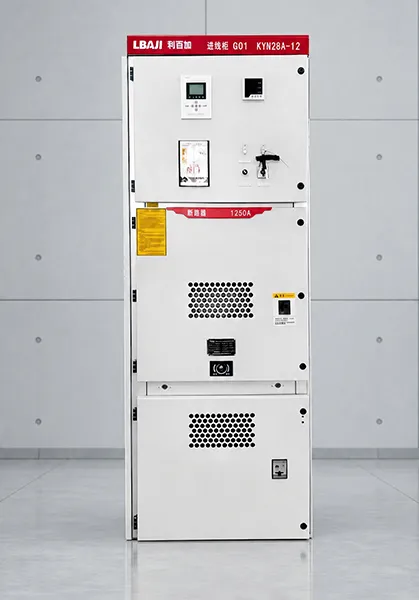
Understand what the visible product can establish
A photograph of a cabinet is useful for recording panel identity, visible handles, instruments and door arrangements. It cannot establish internal clearances, contact condition, short-circuit capability or the compatibility of a hidden replacement. The accompanying product-based illustrations show cabinet exteriors; they are not service drawings or evidence of an internal parts configuration.
For a withdrawable assembly, the breaker truck, secondary connection, compartment and shutters form an integrated interface. Do not assume interchangeability between panels with similar dimensions. Obtain the manufacturer’s compatibility statement for the installed revision and check the relevant drawings. LBAJI’s KYN28A-12 product page provides a real assembly reference for discussing this distinction, but a project-specific parts request still needs the installed equipment records.
Build a purchase request that can be answered
A useful request contains the equipment identity, part reference if available, quantity, reason for replacement and desired delivery point. Add clear photographs of the existing identification and location when they can be collected safely under the site’s procedures. Include the relevant drawing page and revision. State whether the request is for an identical original part, an approved equivalent or a proposed modernization. These are different scopes and should receive different responses.
Describe the failure or shortage without turning an observation into an unsupported diagnosis. For example, a missing position indication does not by itself prove that an auxiliary switch has failed. A qualified assessment may find a circuit, supply or mechanical issue. Separating the observation from the diagnosis helps prevent buying a spare that cannot resolve the actual problem. Record who owns the diagnostic decision and who approves the replacement.
Electrical ratings need context
Compare the characteristics relevant to the part’s role, including system voltage, current duty, control supply and interface requirements. Where interruption or withstand capability is involved, the applicable assembly design and verification records matter. Do not infer a complete assembly rating from a replacement device’s nameplate. A rating is meaningful only with its stated conditions and the equipment to which it applies.
The IEC publication describing metal-enclosed AC switchgear provides an assembly-level standards context for equipment within its stated voltage range. Low-voltage assemblies use a different standards framework. The responsible engineer should identify the applicable edition, equipment class and contractual requirements. A spare-parts buyer should request the necessary evidence rather than copy values from a different project or use a generic online table as approval.

Relay replacement includes information work
Replacing a protection relay can require a review of measurements, outputs, communications, logic and settings. A device with a similar front panel may have a different input arrangement or firmware behavior. The replacement plan should identify which information is preserved, what is recalculated and how the new implementation will be verified. A settings file is a controlled engineering record, not an optional accessory to the purchase.
Define ownership before ordering. The supplier may provide the hardware, while the site’s protection engineer owns the setting review and the commissioning team owns functional verification. Specify the available backups and required deliverables. Do not energize a changed protection arrangement on the assumption that factory defaults represent the approved plant protection scheme. The scope must include a documented acceptance decision by the responsible personnel.
Distinguish original, equivalent and reconditioned parts
An original part should be traceable to the required reference and equipment revision. An equivalent needs a documented basis for compatibility and acceptance. A reconditioned part needs a clear description of its previous condition, work performed, tests, limitations and warranty. These labels are not interchangeable, and none should be inferred from an online photograph or a seller’s general description.
For obsolete equipment, request an explicit proposal rather than an informal assurance that the part should fit. The proposal should say whether the work preserves the existing arrangement or constitutes a retrofit. Record the effect on drawings, maintenance instructions, spare stock and verification responsibilities. If compatibility cannot be established, treat the issue as an engineering decision about the assembly rather than repeatedly searching for visually similar parts.
Choose stock by consequence and lead time
A sensible spare strategy starts with the consequence of equipment unavailability, the likelihood of needing the part and the replenishment lead time. A critical item may justify local stock even when its price is high. A readily available item may not need the same stock level. The decision should use plant experience and supplier evidence; this article does not prescribe a universal spare percentage or replacement interval.
Group stock by confirmed interchangeability, not by broad product family. Keep storage conditions, shelf-life restrictions and periodic checks from the manufacturer’s instructions. A spare that has deteriorated in storage is not operational resilience. Maintain a record of which installed equipment each item supports, and review the record when assemblies, relays or operating mechanisms are modified.
Receiving inspection closes the identification loop
At delivery, compare the supplied identity and documents with the approved order. Check quantity, visible transport condition, references and agreed test records. Preserve packaging and storage requirements where specified. A purchase-order match does not replace the technical acceptance checks required for installation, but it prevents an incorrect or undocumented item entering spare stock unnoticed.
If the delivered part differs from the approved reference, quarantine it under the site’s process and resolve the deviation. Do not silently relabel it as equivalent because delivery is urgent. The resolution should identify the difference, the supporting evidence and the person authorizing acceptance. Keep the final decision linked to the equipment and order so that the next maintenance team can understand what was installed and why.

Plan the work before the outage
A spare-parts order is only one part of a repair or replacement plan. Qualified personnel must establish the safe work scope, isolation requirements, procedures and post-work tests. OSHA’s electrical work-practice requirements describe the safety framework for applicable U.S. work. Site procedures and local rules govern the actual job. This guide intentionally avoids step-by-step work on energized equipment.
Prepare an outage checklist covering personnel, approved instructions, replacement documentation, test equipment and acceptance responsibilities. Include a contingency if the installed interface differs from the records. Time pressure should not convert an unresolved compatibility question into an installation decision. Closing the documentary questions before the outage often reduces delays more effectively than ordering several unverified alternatives.
Request the final record, not just the part
The completed replacement record should identify the supplied part, equipment location, accepted compatibility basis, work performed and relevant verification results. Update drawings and stock records where needed. If settings, wiring or interfaces changed, preserve the approved revisions and backups. A future buyer should be able to identify the part without reconstructing the entire job from email fragments.
For an initial inquiry, send the assembly reference, relevant drawings and the requested component scope. Ask the supplier to identify missing information and any proposed deviation explicitly. A clear response will distinguish confirmed compatibility from matters awaiting engineering review. That distinction protects the buyer from mistaking a quotation for a complete technical approval.
Frequently asked questions
Can I buy a replacement by photograph alone?
A photograph can help identify visible features, but compatibility needs equipment references, drawings and the relevant manufacturer’s information. Appearance alone is insufficient.
Is a higher current rating automatically a better spare?
No. Mechanical interfaces, control functions and assembly conditions also matter. A higher number on one rating does not establish an approved replacement.
Does a new relay keep the old settings automatically?
No. Inputs, outputs, logic, firmware and settings must be reviewed and verified within the defined replacement scope.
What should I do when the original part is obsolete?
Request a documented equivalent or retrofit proposal and obtain engineering acceptance for the installed assembly. Do not improvise a replacement from appearance.
What is the most useful information in a first inquiry?
The assembly identity, circuit location, part reference, drawing revision, quantity and observed problem allow a supplier to identify the scope and missing evidence.
Technical references and related equipment
The linked standards pages describe their scope; project compliance requires the applicable documents and engineering review.
- IEC metal-enclosed AC switchgear scope
- 29 CFR 1910.333 electrical work practices (official 2025 edition)
- LBAJI KYN28A-12 Metal-clad Withdrawable AC Switchgear
- switchgear fundamentals
- switchgear verification and testing
- switchgear maintenance planning
Further learning: equipment fundamentals
This independent educational video supports the background discussion of equipment functions. It does not replace approved project documents or qualified electrical work procedures. Source: Gaurav J – TheElectricalGuy.

Watch Switchgear Basics: Complete Beginner's Guide | TheElectricalGuy