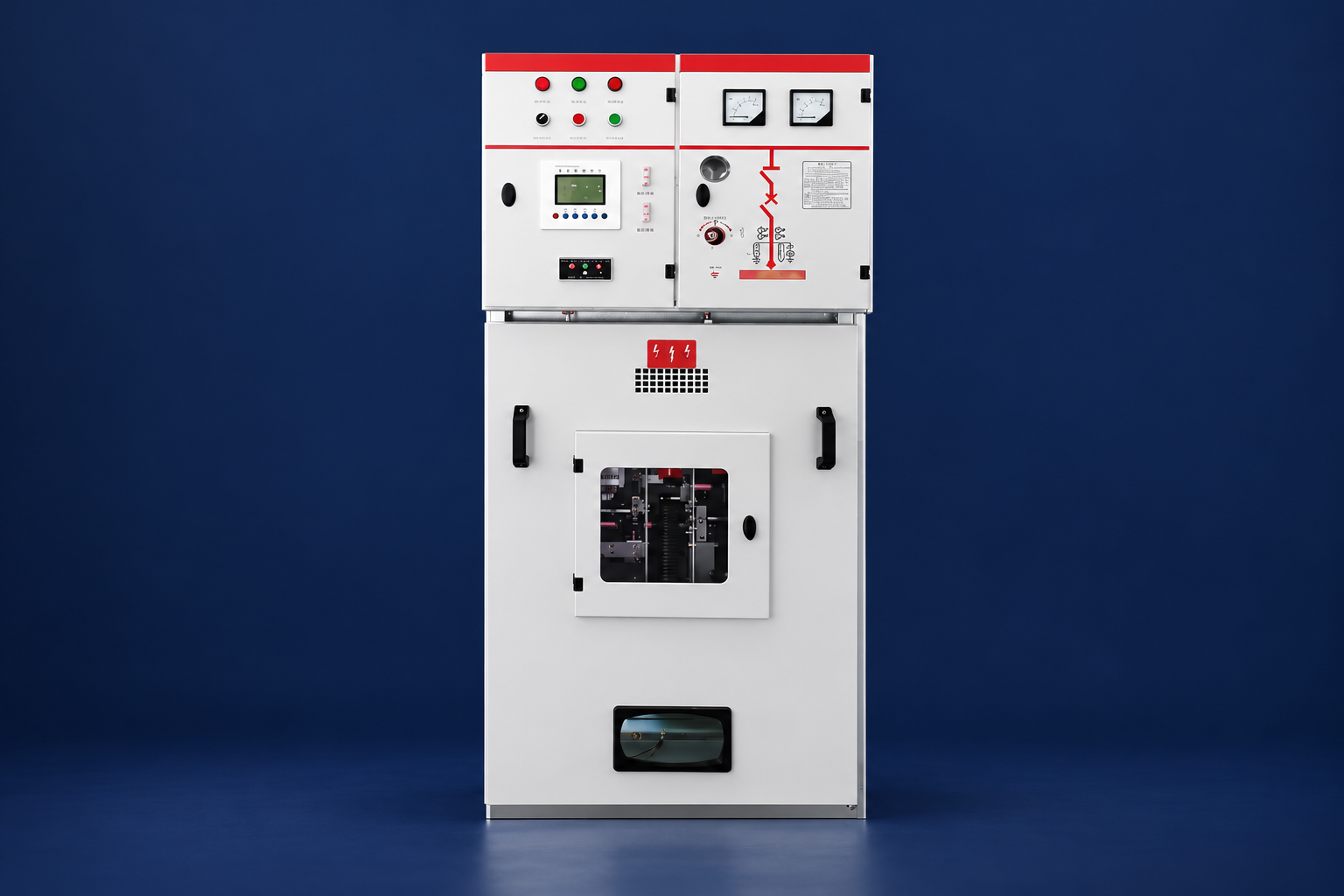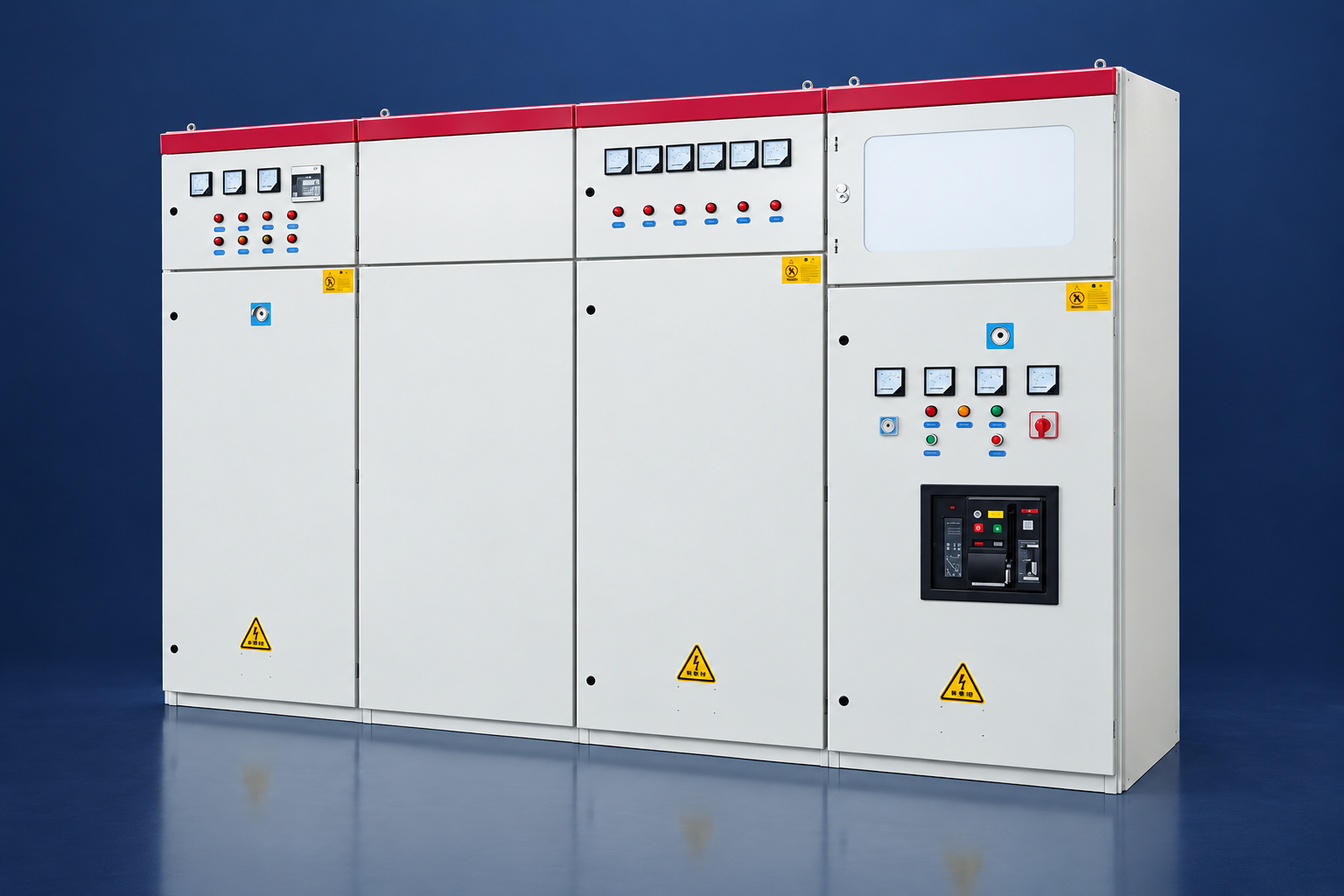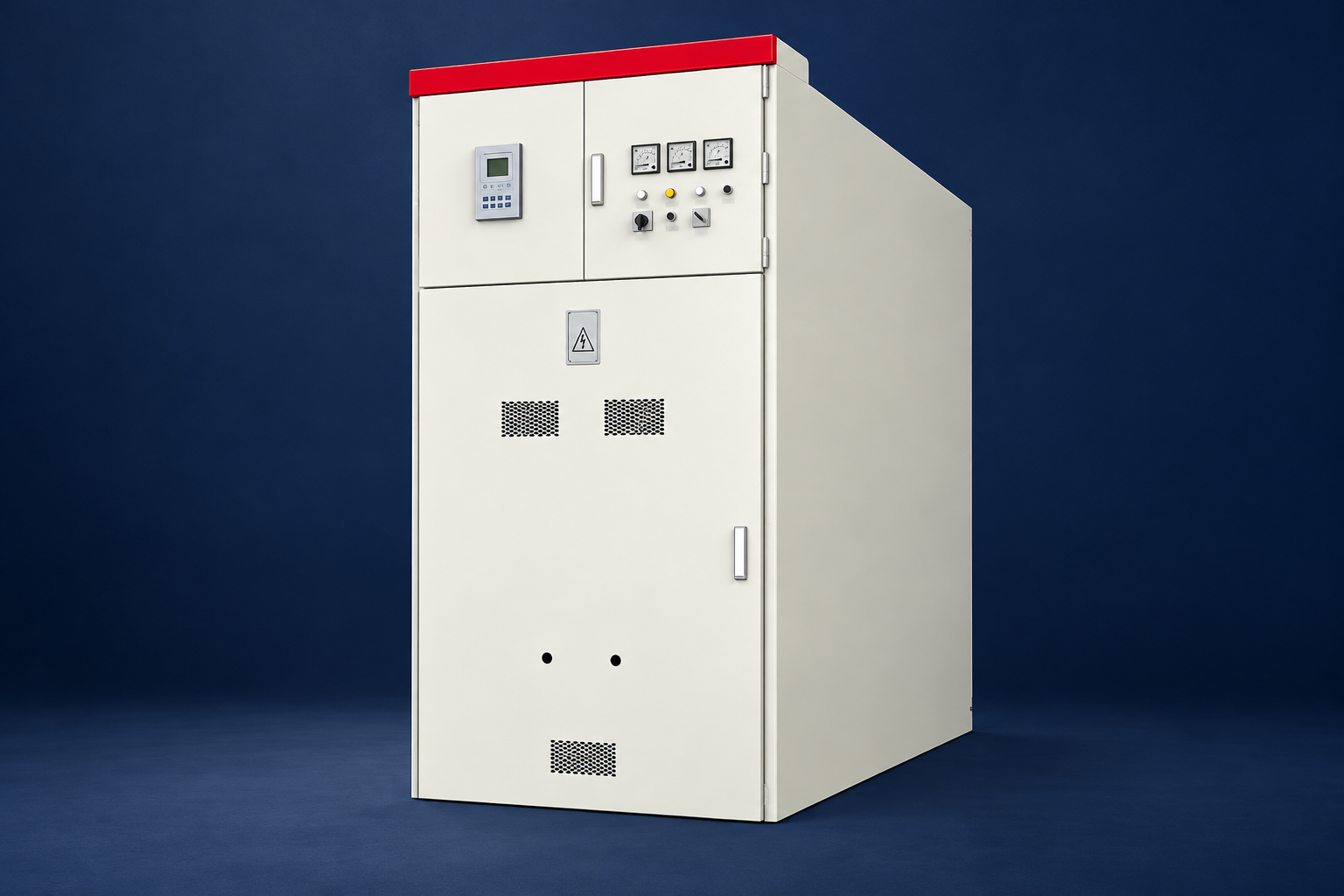

Switchgear is the coordinated assembly that switches, protects, controls and isolates electrical circuits. It connects sources such as utility feeders, transformers and generators to outgoing loads while giving operators a controlled way to clear faults and perform maintenance. This guide explains what electrical switchgear does, its essential components and ratings, and the practical differences between low-, medium- and high-voltage, air- and gas-insulated, metal-clad and ring-main designs.
What Does Switchgear Do?
During normal operation, switchgear carries load current and allows planned switching. During a fault, instrument transformers and protection relays detect abnormal conditions and command a circuit breaker to interrupt the current. Disconnectors and earthing switches then establish a safe work zone. Modern assemblies also provide metering, interlocking, local indication, remote control and communications to a supervisory system.
The essential features of switchgear are adequate insulation, continuous-current capability, fault interruption and withstand, selective protection, safe isolation, reliable interlocking and maintainable construction. A cabinet with a breaker is not automatically a complete protection system; the breaker, relay, CTs, control supply, busbar and enclosure must be engineered together.
Switchgear by Voltage Class
Low-voltage switchgear
Low-voltage assemblies distribute power below the applicable LV limit, commonly from a transformer secondary. They may include air or molded-case circuit breakers, fuse switches, motor feeders, capacitor banks, automatic transfer controls and metering. Form of separation, short-circuit withstand, busbar temperature rise and protective-device coordination are major design considerations.
Medium-voltage switchgear
Medium-voltage switchgear serves industrial plants, renewable-energy systems, buildings and utility distribution. Vacuum circuit breakers are common because they combine good electrical endurance with sealed interrupters. Metal-clad designs use grounded partitions to separate major compartments and often use withdrawable breakers for test and service positions.
High-voltage switchgear
High-voltage equipment is engineered as part of a substation and may use air-insulated or gas-insulated arrangements. System studies, insulation coordination, lightning impulse rating, switching duty, clearances and substation layout are decisive. “High tension switchgear” is an older regional term and should not replace the actual rated voltage in a specification.
Quick Comparison and Selection Table
Use this table as a quick review of the main engineering and procurement decisions explained in the article.
| Decision area | Practical meaning | What to verify |
|---|---|---|
| What Does Switchgear Do? | During normal operation, switchgear carries load current and allows planned switching. | During a fault, instrument transformers and protection relays detect abnormal conditions and command a circuit breaker to interrupt the current. |
| Switchgear by Voltage Class | Low-voltage assemblies distribute power below the applicable LV limit, commonly from a transformer secondary. | They may include air or molded-case circuit breakers, fuse switches, motor feeders, capacitor banks, automatic transfer controls and metering. |
| Metal-Clad vs Metal-Enclosed Switchgear | Metal-clad switchgear is a specific construction with grounded metal barriers between major primary compartments, insulated main conductors and a drawout circuit breaker. | Metal-enclosed is a broader description that can include different internal arrangements and switching devices. |
| Air-Insulated vs Gas-Insulated Switchgear | Air-insulated switchgear (AIS) uses air as the principal external insulation within the enclosure. | It is familiar, accessible and often economical where space is available. |
| Ring Main Unit vs Circuit-Breaker Switchgear | A ring main unit provides compact load switching, isolation and feeder protection in a distribution ring. | Some ways use load-break switches and fuses, while others use circuit breakers and relays. |
Metal-Clad vs Metal-Enclosed Switchgear
Metal-clad switchgear is a specific construction with grounded metal barriers between major primary compartments, insulated main conductors and a drawout circuit breaker. Metal-enclosed is a broader description that can include different internal arrangements and switching devices. The terms should not be treated as synonyms in procurement; require the relevant construction standard and type-test evidence.
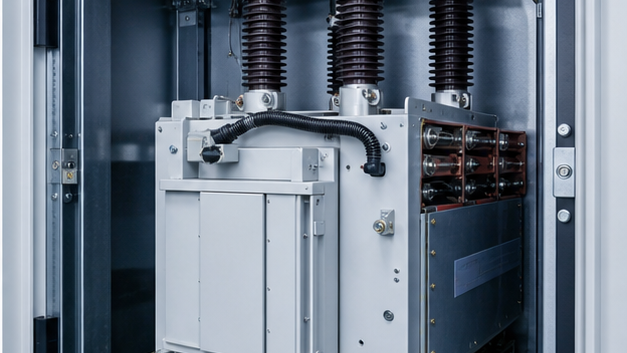
LBAJI’s KYN28A-12 withdrawable switchgear is intended for 12 kV-class distribution, while the KYN61-40.5 platform addresses 40.5 kV-class applications. Project voltage, fault level, current, internal-arc requirement and local standards must be confirmed before selecting a model.
Air-Insulated vs Gas-Insulated Switchgear
Air-insulated switchgear (AIS) uses air as the principal external insulation within the enclosure. It is familiar, accessible and often economical where space is available. Its footprint and environmental exposure can be greater.
Gas-insulated switchgear (GIS) encloses energized parts in sealed insulation, reducing footprint and limiting exposure to dust, salt and humidity. Conventional SF6 switchgear has excellent dielectric performance but SF6 has a high global-warming impact, so leak management and regional rules matter. Newer sealed products may use alternative gases or solid/air hybrid insulation. Ask the manufacturer to state the insulating medium, leakage specification and end-of-life procedure.

For compact distribution rings, review the LBHB-12 environmentally friendly gas-insulated RMU. At higher voltage, the HC-40.5 sealed ring-network switchgear demonstrates a compact insulated approach.
Ring Main Unit vs Circuit-Breaker Switchgear
A ring main unit provides compact load switching, isolation and feeder protection in a distribution ring. Some ways use load-break switches and fuses, while others use circuit breakers and relays. Full metal-clad circuit-breaker switchgear normally offers greater protection flexibility, higher ratings and maintainability for primary industrial distribution. The choice depends on network topology, fault duty, protection philosophy, operator access and continuity requirements.
Pad-Mounted and Outdoor Switchgear
Pad-mounted switchgear places distribution switching in a weather-resistant, tamper-resistant ground-level enclosure. It is common in underground utility networks, campuses and renewable sites. Specifications should define enclosure corrosion class, ingress protection, operating access, visible isolation requirements, cable interfaces, wildlife protection and environmental conditions.
Generator and Paralleling Switchgear
Generator switchgear connects and protects a generator source. Paralleling switchgear additionally synchronizes and shares load among generators or between generators and a utility source. It requires voltage, frequency and phase-angle checks, load-sharing controls, reverse-power protection, interlocking and a documented operating sequence.
Critical Switchgear Ratings
- Rated voltage and insulation level: must match maximum system voltage and overvoltage environment.
- Rated current: applies to busbars and individual functional units under stated ambient conditions.
- Short-time withstand current: the assembly must carry the specified fault current for the rated duration.
- Peak withstand and making current: addresses the first-cycle electrodynamic stress.
- Breaking current: the breaker must interrupt the prospective fault current at its rated voltage.
- Internal-arc classification: defines tested accessibility, current and duration; it does not remove the need for safe work practices.
- Ingress and environmental rating: must reflect dust, water, condensation, corrosion, altitude and temperature.
How to Compare Switchgear Proposals
- Issue a single-line diagram, load list, system studies and operating philosophy.
- Compare compliance against one requirement schedule, not marketing descriptions.
- Verify type-test reports apply to the offered construction and ratings.
- Check breaker, relay, CT, cable and busbar interfaces.
- Review dimensions, transport sections, access clearances and cable bending space.
- Confirm mechanical and electrical interlocks and earthing provisions.
- Evaluate spare parts, training, documentation and lifecycle support.
- Define factory acceptance and site commissioning tests before ordering.
Safety and Maintenance
Switchgear contains hazardous energy even when a breaker appears open. Safe work requires an approved switching procedure, lockout/tagout, isolation, absence-of-voltage verification, grounding and arc-flash controls. Remote operation and arc-resistant construction can reduce exposure but do not replace the safety program.
Condition-based maintenance combines visual inspection, cleaning, mechanism checks, contact resistance, insulation assessment, relay diagnostics and thermography. Gas pressure or density, partial discharge and breaker timing may be monitored where applicable. Maintenance intervals should follow the manufacturer, operating duty and environmental severity.
Core components inside switchgear
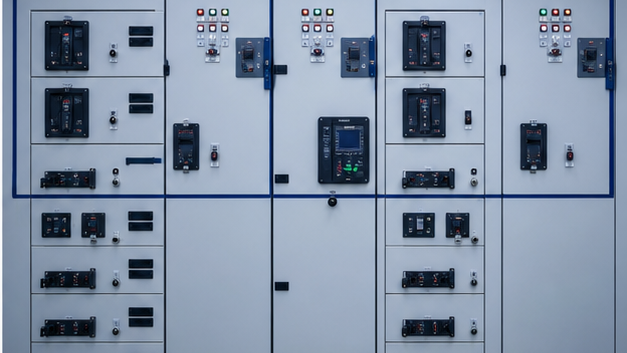
A switchgear lineup normally combines busbars, circuit breakers or switches, disconnecting and earthing functions, instrument transformers, relays, meters, control power, interlocks and cable compartments. Medium-voltage metal-clad construction separates major functions with grounded barriers, while other metal-enclosed designs may use fused switches or fixed devices.
Switchgear safety and serviceability
Safe selection considers internal-arc classification, pressure relief, remote operation, shutters, interlocking, grounding, access and the energy available at the bus. Maintenance planning should define isolation points, test positions, withdrawal space, spare parts and extension arrangements before the room and cable routes are finalized.
Technical references and further reading
The following independent sources support the standards, terminology, calculations, and safety context discussed in this guide:
- IEC 62271-200 metal-enclosed switchgear standard — Scope, classifications, service conditions, internal-arc testing, interlocks, and requirements for AC metal-enclosed switchgear up to 52 kV.
- IEEE C37.121 guide for switchgear-unit substations — Coordination guidance for switchgear and transformer sections in three-phase unit substations.
- OSHA electrical power safety requirements — Safety requirements for construction involving electric power transmission and distribution equipment.