
Industrial control panels integrate power distribution, motor control, automation, safety and operator interfaces in an engineered enclosure; reliable design begins with a functional specification, load list and I/O schedule rather than a cabinet layout. The panel assembly must coordinate voltage, SCCR, protection, heat, environment, segregation, wiring, machine safety, communications, documentation and factory testing.
Key Takeaways
- Define functions and failure states before choosing components.
- SCCR and thermal performance belong to the complete assembly.
- Drawings, software backups and test records are deliverables.
Power, Motor and Control Architecture
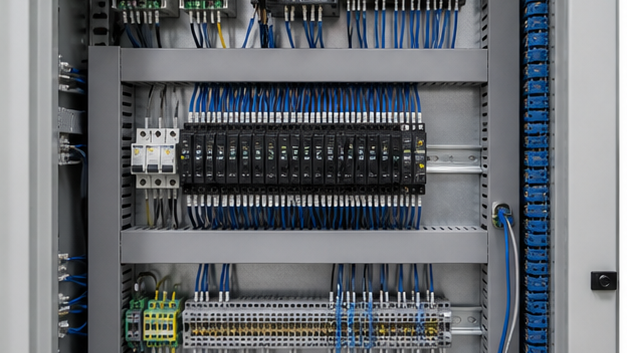
Incoming isolation and protection feed branch breakers or fuses, contactors, overload relays, drives, power supplies and transformers. Separate power and control paths in the schematics and layout. Motor starting method follows load torque, process needs and supply limitations.
Control voltage, grounding and protective bonding require deliberate design. DC supplies should include load, inrush, redundancy and hold-up requirements.
PLC, I/O, Safety and Communications
The I/O list identifies signal type, voltage, source/sink convention, isolation, channel use and field terminal. Network architecture defines protocols, addressing, managed switches, remote access and cybersecurity ownership.
Safety functions require risk assessment, required performance level or SIL, validated architecture and proof testing. A standard PLC instruction does not replace a safety-rated function where one is required.
SCCR, Protection and Thermal Design
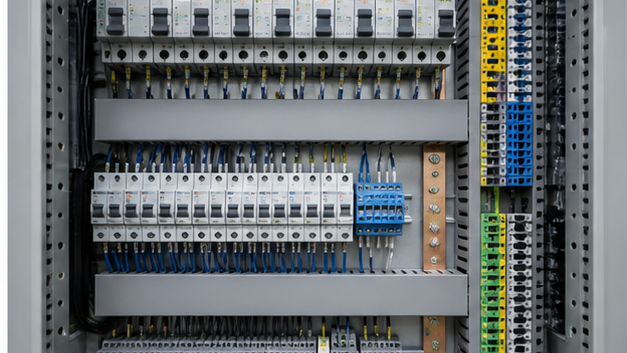
The panel short-circuit current rating is not automatically the rating of the main breaker. Component combinations, feeder protection and tested or permitted methods establish the assembly SCCR. It must meet available fault current at the installation.
Heat from drives, power supplies, transformers and contactors is compared with enclosure dissipation and ambient. Fans, filtered ventilation, heat exchangers or air conditioners require maintenance and condensation planning.
Industrial Control Panel Design Review Table
| Area | Required input | Design output | Acceptance evidence |
|---|---|---|---|
| Power | Load list and source fault current | One-line, devices and SCCR | Calculations and labels |
| Automation | Functional description and I/O | PLC architecture and software | Simulation and sequence test |
| Safety | Risk assessment | Safety functions and circuits | Validation report |
| Thermal | Losses, ambient and enclosure | Cooling and spacing | Temperature calculation/test |
| Documentation | Tag and drawing standards | Schematics, lists and backups | As-built package |
Layout, Wiring and Factory Acceptance
Segregate noisy drive output and power wiring from low-level signals. Observe bend radius, terminal ratings, duct fill, creepage, clearance and service space. Label devices, wires, terminals and cables consistently with drawings.
FAT should check workmanship, point-to-point wiring, protective continuity, insulation where appropriate, settings, safety circuits, alarms, sequences, communications and recovery after power loss. Record firmware and software versions.
Engineering Validation and Safety Boundary
This guide supports specification and procurement; it does not replace a project study, the applicable code, the manufacturer instructions or work by qualified electrical personnel. Verify the following before equipment selection, testing, wiring or energization:
- Verify available fault current and complete panel SCCR.
- Validate safety functions independently from normal control.
- Check heat dissipation at maximum ambient and load.
- Separate power, drive, communication and analog wiring.
- Test loss and restoration of power and communications.
Information to Include in the RFQ
A useful quotation must be based on the same technical boundary for every supplier. Include the following information and require all deviations to be listed explicitly:
- Functional description, load list, I/O and sequence of operation.
- Supply voltage, fault current, control voltage and grounding.
- Motors, drives, safety functions and network protocols.
- Environment, enclosure, cooling, cable entry and dimensions.
- Standards, drawings, software, FAT, spares and training.
From Technical Data to an Approved Decision
Use a staged review rather than approving the first catalogue match. Begin with power, motor and control architecture, then reconcile plc, i/o, safety and communications with sccr, protection and thermal design. Complete the review with layout, wiring and factory acceptance. At each stage, record the source document, units, operating case and person responsible for approval. This prevents a value copied from an old drawing, nominal system label or unrelated product from becoming an uncontrolled design input.
Before acceptance, compare the supplier response line by line with the RFQ and mark every exception. Confirm that drawings, calculations, settings, certificates and test reports refer to the exact offered model and revision. Preserve the approved submittal, nameplate data, factory results and commissioning measurements as the maintenance baseline. If a rating, connection, environment or test condition changes, repeat the affected review rather than assuming the original conclusion remains valid.
Document control should identify revision, approval status and superseded files. Field teams should receive the same approved values used for procurement, while commissioning records should capture any authorized change made during installation. This traceability is especially important when equipment is replaced years later: the next engineer needs verified interfaces and test history, not an incomplete description copied from a purchase order.
Coverage Informed by Current Search Results
The current U.S. Google top-20 review repeatedly surfaced themes including Overview of industrial control panels, Key components of a control panel, UL 508A Third Edition Summary of Requirements, PLC Control Panels, DESIGN. The article addresses those user needs in an original engineering and procurement sequence; competitor brand navigation and unrelated sales material were excluded.
Related LBAJI Resources
Continue with electrical control panel guide low-voltage switchgear guide distribution cabinet products. These resources help connect the calculation or component decision to a complete transformer, switchgear, control or distribution specification.
Technical References and Further Reading
- NFPA 79 — Industrial machinery electrical standard.
- OSHA Machine Guarding — Safety context for machinery.
- NIST Cybersecurity Framework — Industrial network risk management.
Conclusion
A high-quality industrial control panel is the physical result of a controlled functional, electrical and safety design. Verify SCCR, temperature, logic, safety and documentation as one assembly before shipment.