
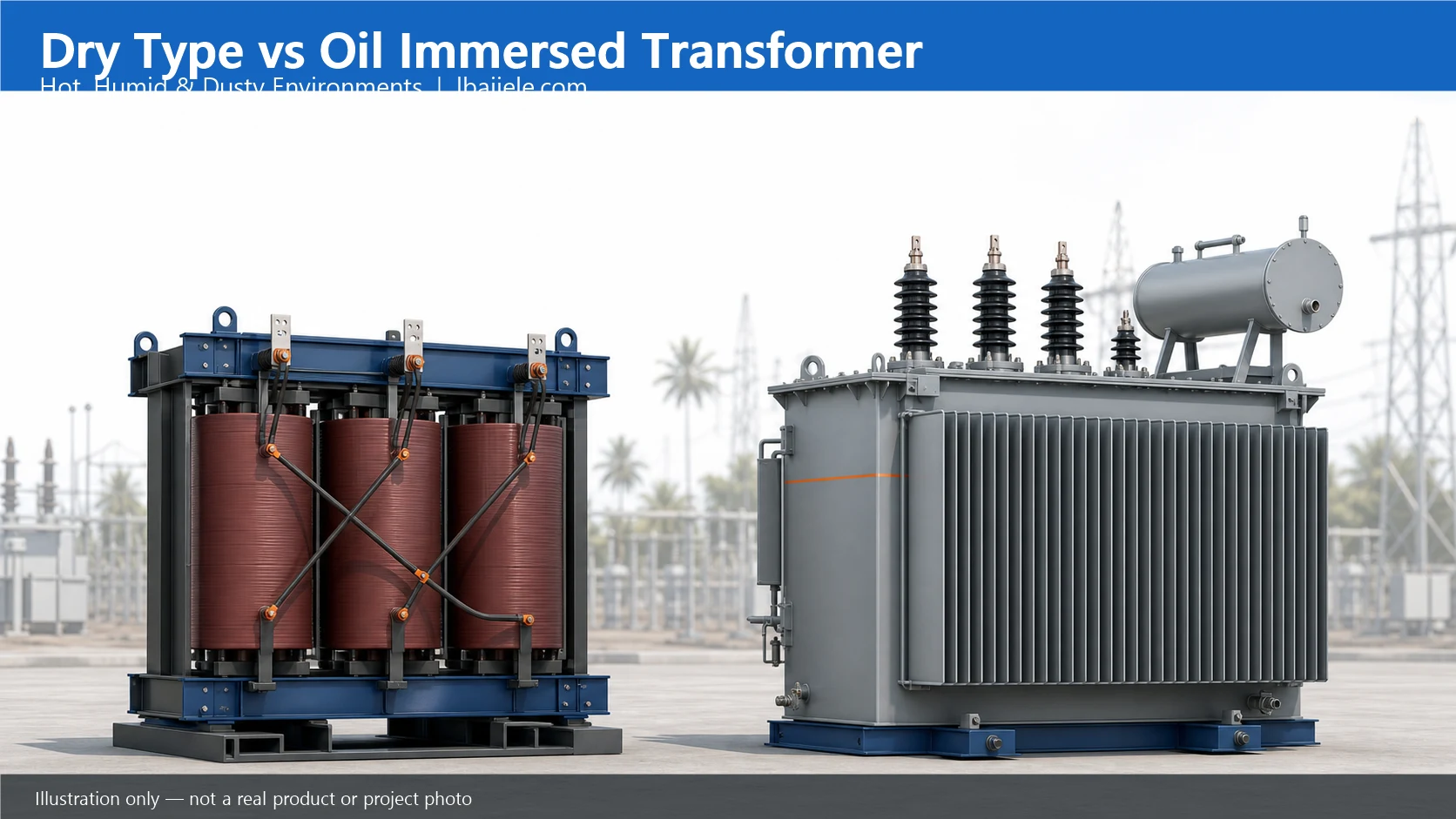
Choosing between dry type and oil immersed transformers starts with site constraints, not headline efficiency claims. For the broader construction and project-selection overview, see our dry-type transformer types and ratings guide.
Distribution projects need a technology fit review before kVA and voltage details are frozen. This comparison guide helps specifiers, EPC teams, and importers align cooling class, room or yard layout, and lifecycle cost—not generic marketing labels.
Cross-check options against your single-line diagram, utility requirements, and maintenance plan before issuing an RFQ.
Contents
- Part 1. When the technology choice matters
- Part 2. Side-by-side comparison at a glance
- Part 3. Site, environment, and installation fit
- Part 4. Losses, efficiency, and lifecycle cost
- Part 5. Safety, fire risk, and maintenance
- Part 6. Product recommendation and Fit Boundary
- Part 7. Common comparison mistakes
Part 1. When the technology choice matters
Technology selection should precede detailed loss tables and impedance negotiations.
Indoor commercial buildings, hospitals, and transit hubs often favor dry type units when ventilation and fire separation can be engineered.
Outdoor industrial yards, utility secondary networks, and pad-mount applications frequently favor oil immersed designs when oil containment and ONAN cooling are acceptable.
Neither technology wins on kVA alone—rated kVA and voltage combination, vector group and tap range, and cooling method and enclosure must match the approved design.
For related context, see the what is a dry type power transformer.
For related context, see the oil immersed distribution transformer guide.
Part 2. Side-by-side comparison at a glance
Use the matrix below in early design reviews. Confirm final values on issued datasheets.
| Factor | Dry type (resin/cast coil) | Oil immersed (ONAN) |
|---|---|---|
| Typical installation | Indoor electrical room, ventilated | Outdoor pad, substation yard, or dedicated vault |
| Fire and spill risk | Lower liquid spill concern; ventilation critical | Oil containment and fire separation often required |
| Maintenance | Filter/fan service, surface cleaning | Oil sampling, gasket/bushing inspection |
| Audible noise | Often higher at same kVA in rooms | Often lower at distance outdoors |
| Overload strategy | Forced-air cooling optional per design | ONAN with documented overload curves |
| Short-circuit impedance | Confirm per protection study | Confirm per protection study |
| Relative first cost | Often higher at same kVA indoors | Often lower for outdoor distribution ratings |
| Lifecycle no-load and load losses | Compare at same reference temperature | Compare at same reference temperature |
Document which loss basis each vendor uses before normalizing bids.
Part 3. Site, environment, and installation fit
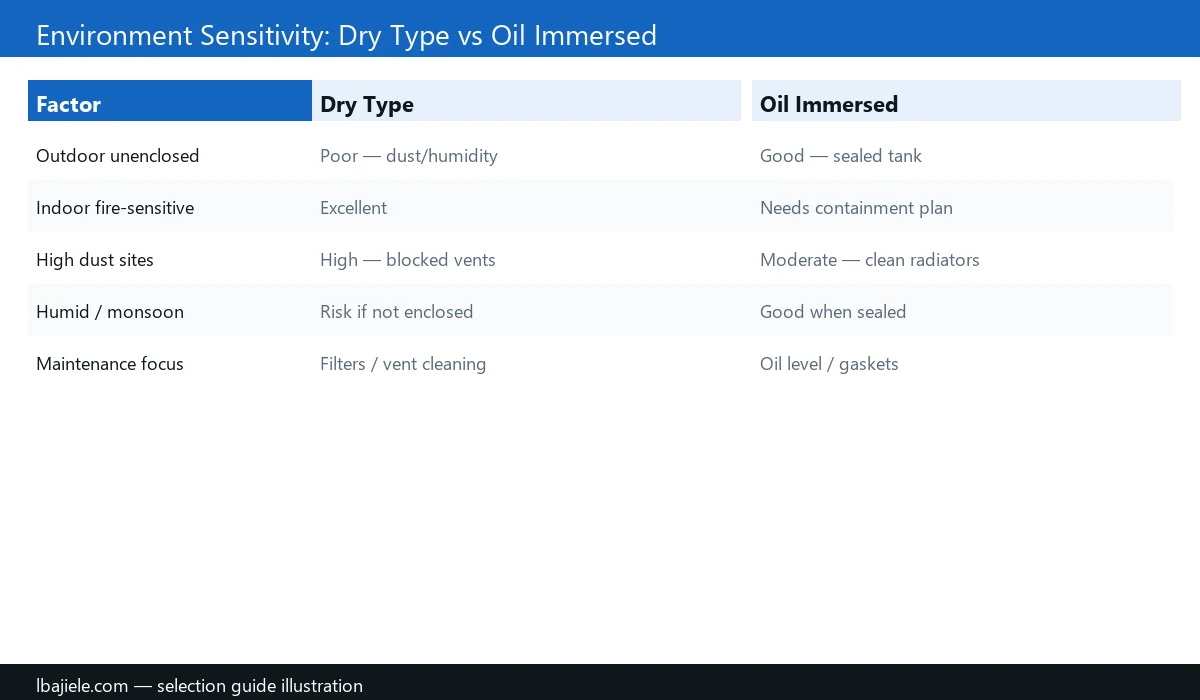
Altitude, ambient temperature, dust, and humidity affect both technologies.
Dry type rooms need clearances, intake/exhaust paths, and access for lifting and cable termination.
Oil immersed installations need bunding or spill control where codes require it, plus lifting plans for tank weight and oil volume.
Hot, humid, or dusty environments may push teams toward sealed enclosures or outdoor oil units—confirm with the authority having jurisdiction before layout freeze.
Part 4. Losses, efficiency, and lifecycle cost
Compare no-load and load losses at the same reference temperature and connection group.
A lower first cost unit with higher losses can exceed lifecycle cost of a higher-efficiency alternative over 20–30 years of operation.
Record expected load factor and operating hours in the RFQ so vendors return comparable loss certificates.
Part 5. Safety, fire risk, and maintenance
Dry type designs reduce flammable liquid in occupied buildings but still require thermal monitoring and ventilation maintenance.
Oil immersed units depend on oil quality, pressure relief, and bushing integrity—plan sampling intervals in the O&M manual.
Training for local staff should cover lockout/tagout, confined-space rules for vaults, and alarm response before energization.
Part 6. Product recommendation and Fit Boundary
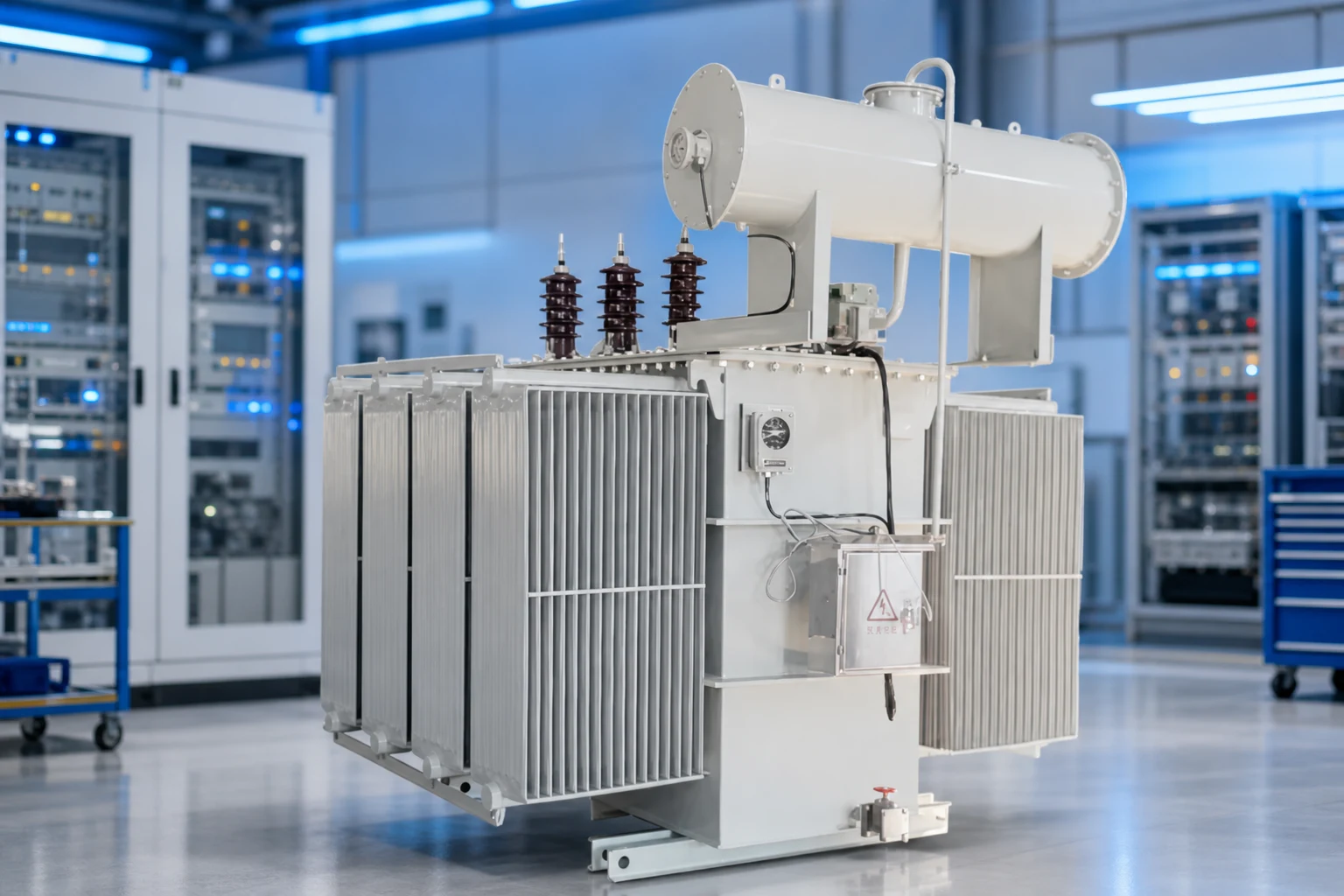
Product recommendation: Start technology selection at the transformer product category, then narrow to the SC(B) resin insulated dry transformer series for indoor resin-insulated options or the S□-M oil-immersed power transformer series for oil immersed distribution ratings.
| Better fit | Poor fit without extra study |
|---|---|
| Documented indoor/outdoor constraint and maintenance plan | Technology chosen only from brochure photos |
| Teams that can supply ventilation or containment details | Rush PO before single-line diagram approval |
| Projects comparing losses on a common engineering basis | Assumed utility approval without interconnection data |
Submit voltage class, cooling preference, ambient conditions, and required test documents through Contact Us for model-specific confirmation.
Part 7. Common comparison mistakes
- Selecting dry type without a ventilation and clearance study for the actual room.
- Placing oil immersed units indoors without approved containment and fire separation.
- Comparing quotations with different impedance bases or loss reference temperatures.
- Ignoring audible noise limits for dry type rooms near occupied spaces.
- Treating marketing efficiency claims as substitutes for loss certificates.
- Mixing pad-mount outdoor duty with indoor dry-type nameplate assumptions.
FAQ
When should I choose dry type over oil immersed?
Choose dry type when indoor installation, reduced flammable liquid exposure, and maintainable ventilation are priorities and the room design supports clearance and cooling.
When is oil immersed the better default?
Oil immersed units often fit outdoor distribution yards, utility secondary feeds, and projects where ONAN cooling and established oil maintenance practices are acceptable.
Can both technologies serve the same kVA rating?
Yes—many kVA ratings exist in both lines, but site layout, losses, and maintenance differ; compare on project constraints, not kVA alone.
What documents should I request for either technology?
Request type or routine test reports, GA drawings, loss certificates, wiring diagrams, and spare-parts lists for the selected cooling class.
How do I compare losses fairly?
Require no-load and load losses at the same reference temperature and vector group, then apply your expected load factor.
Does indoor dry type eliminate fire planning?
No—ventilation, clearance, and thermal monitoring remain mandatory; confirm local code requirements for electrical rooms.
Can I switch technology late in design?
Late switches often force civil and protection redesign; fix technology before foundation and room layout freeze.