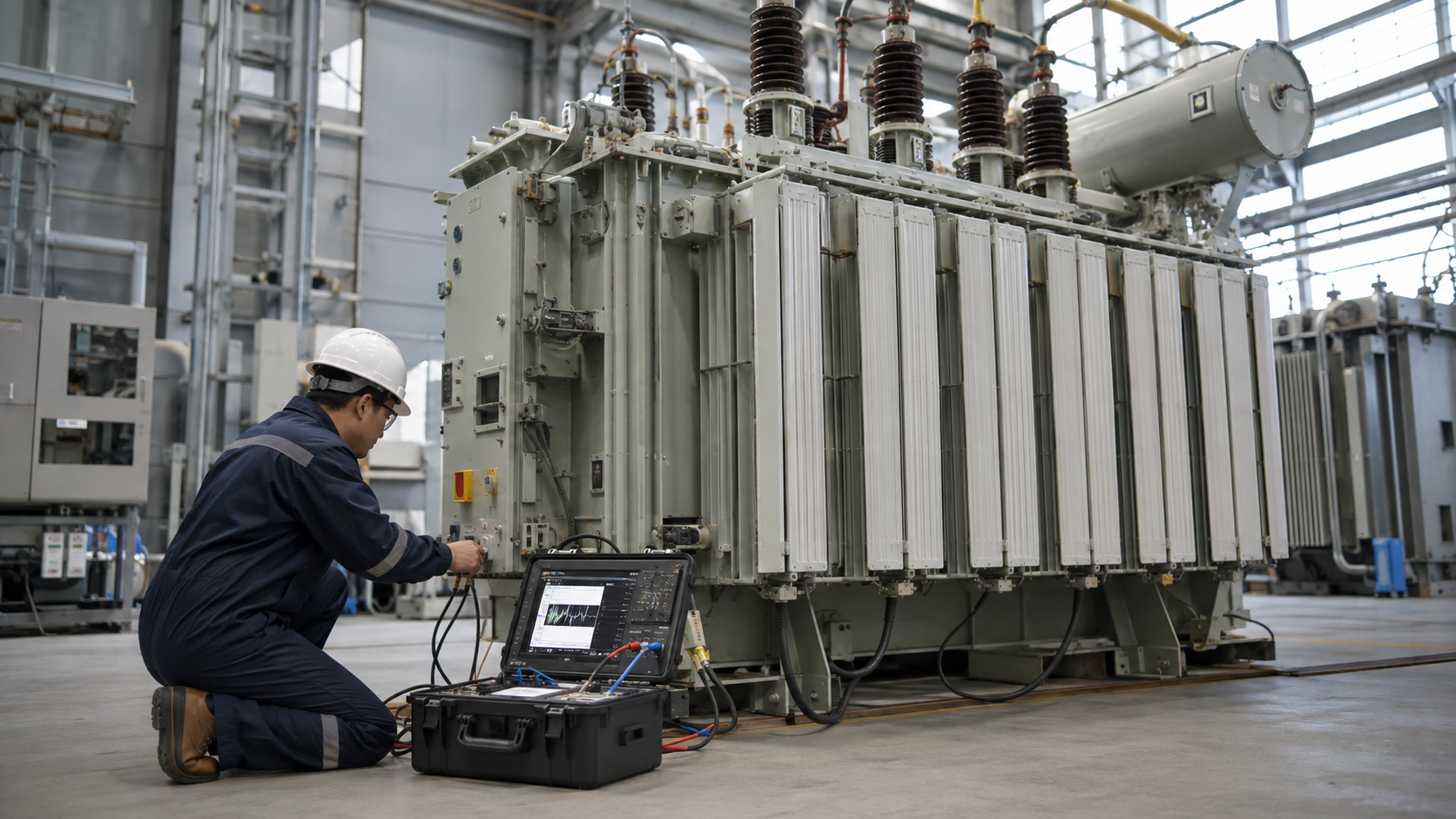

A dry type transformer transfers AC power through windings insulated by solid materials and cooled by air rather than by an insulating liquid. Common designs include open ventilated, vacuum-pressure-impregnated (VPI), cast-resin and non-ventilated units. Each can suit different indoor or industrial conditions, but “dry type” alone does not determine fire rating, weather protection, load capacity or maintenance needs. Select the construction, rating, enclosure and cooling arrangement against the project environment and nameplate requirements.
LBAJI lists both SC(B) resin-insulated dry transformers and SG(B) environment-friendly dry-type transformers. Treat these as separate product families: confirm the exact offered configuration, drawings and guaranteed data for a project rather than assuming every dry-type unit shares the same construction.
How a Dry-Type Transformer Works
A transformer changes AC voltage through magnetic coupling between primary and secondary windings. In a dry-type unit, solid insulation separates energized parts, while air removes heat from the core and windings. The exact winding materials, insulation system, enclosure, cooling paths and protective devices depend on the model.
The key distinction from a liquid-immersed transformer is that the active parts are not immersed in insulating oil or another insulating liquid. That avoids liquid containment and leak-management requirements associated with liquid-filled equipment, but it does not make the transformer fireproof, touch-safe, weatherproof or maintenance-free. Electrical energy, hot surfaces, arc hazards and fire-code requirements remain relevant.
“Dry type” describes an insulation/cooling family, not one fixed design. A low-voltage indoor unit, a medium-voltage cast-resin unit and a non-ventilated control transformer can differ substantially in ratings, cooling and applicable rules.
Types of Dry-Type Transformers
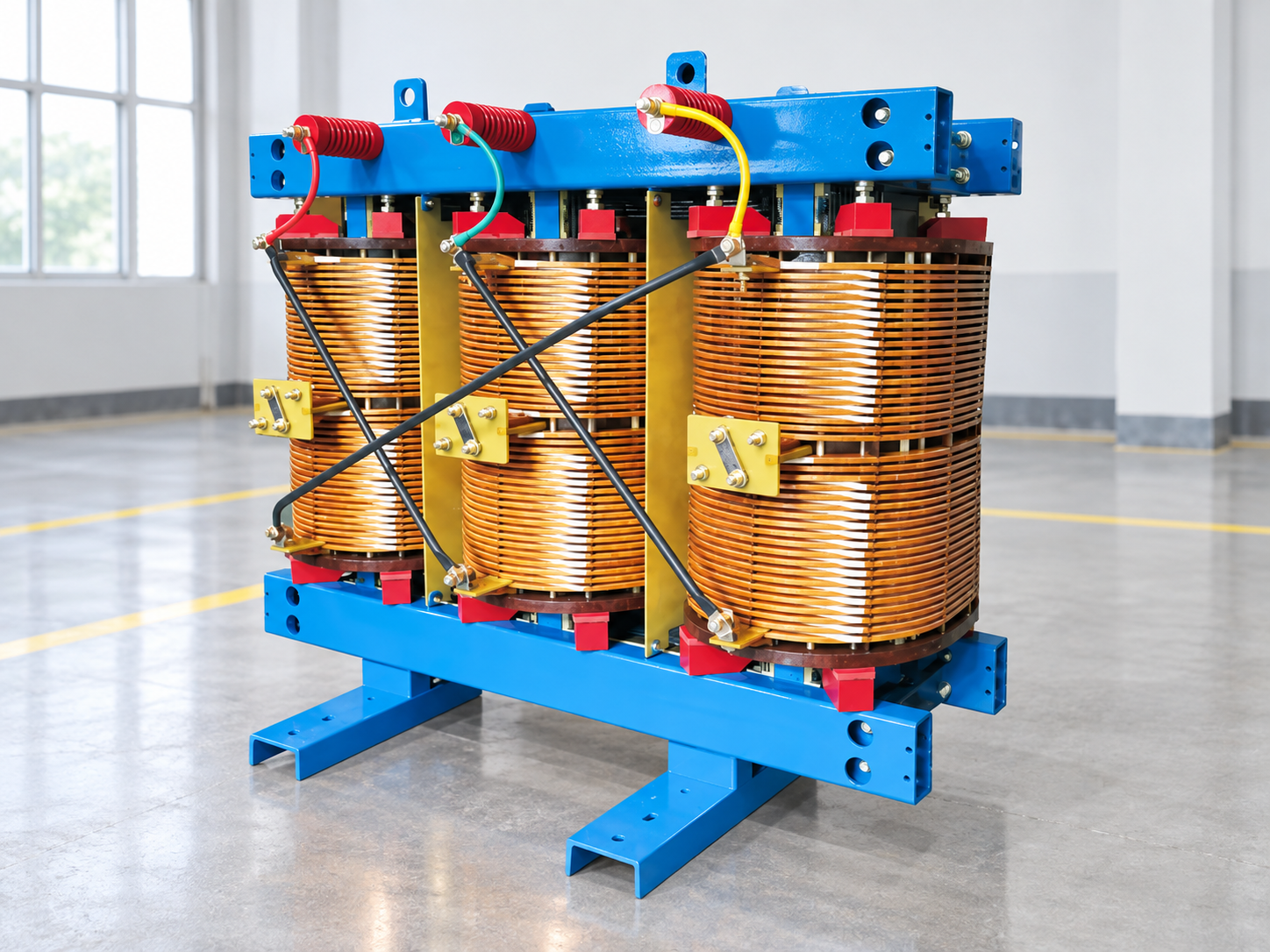
Construction names describe how the windings are insulated and protected. Marketing terms can vary, so compare drawings and construction details instead of choosing from the label alone.
| Construction | What to verify | Typical decision factor | Important limitation |
|---|---|---|---|
| Open ventilated | Coil treatment, enclosure, air path, filters and environment rating | Clean, protected rooms where open airflow and access are acceptable | Dust, moisture, conductive contamination and blocked airflow can affect service conditions. |
| VPI / resin-impregnated | Impregnation process, coil finish, protection against contamination and specified tests | Applications needing a treated winding without a fully cast coil | VPI does not by itself establish an enclosure or environmental class. |
| Cast resin / encapsulated winding | Which winding is encapsulated, environmental and fire-behavior test evidence, cooling surface | Projects that specify a cast winding and documented exposure conditions | “Cast resin” is not an all-weather rating or a substitute for project fire review. |
| Non-ventilated or sealed dry type | Enclosure, heat path, ambient limits and applicable product category | Where external air circulation through coils is intentionally restricted | Heat rejection and the product’s stated scope must be confirmed for the actual duty. |
Some models use fans to increase cooling under defined conditions. Only use a fan-assisted rating when the manufacturer states it for the exact model and duty. If continuous operation depends on fans, include fan status, alarms, replacement access and a failure response in the design review.
Dry-Type Transformer Ratings and Nameplate Data
Start with the full electrical duty, not a rough equipment label. Record rated kVA, primary and secondary voltages, number of phases, frequency, winding connection, vector group where applicable, taps, impedance and the required neutral/grounding arrangement. Also define ambient temperature, altitude, load profile and any short-time or overload requirement.
For a balanced three-phase transformer, the approximate full-load line current is:
I (A) = kVA × 1,000 ÷ (√3 × line voltage)
For a single-phase transformer, use I (A) = kVA × 1,000 ÷ voltage. These equations estimate rated current. They do not select conductors or protective devices and do not replace a short-circuit or coordination study. See the three-phase transformer calculation guide for line and phase relationships, and the transformer sizing guide for a broader load-sizing process.
Check the complete nameplate and data sheet. Insulation system temperature class and permissible winding temperature rise are related but are not interchangeable. An insulation class is not permission to operate above the model’s guaranteed temperature limits. Obtain the stated rating basis, cooling mode, ambient conditions, altitude assumptions, impedance tolerance, losses and test values for the offered design.
Cooling, Temperature and Efficiency
Dry-type transformers reject heat through the designed air path and surrounding surfaces. A room that is too hot, a blocked inlet, recirculated exhaust air or dust-covered cooling passages can undermine the intended thermal conditions. Include heat rejected by transformer losses when checking room ventilation or HVAC capacity.
Ask the supplier to state no-load loss, load loss, test basis and guaranteed efficiency for the requested voltage, frequency and rating. No-load loss is associated with energizing the core; load loss includes winding and other load-related losses. The U.S. distribution-transformer rules define these terms and related test requirements for covered equipment. Compare offers at the same rating and reference conditions rather than relying on a single efficiency percentage without its test point.
Harmonic-producing loads can add winding and stray losses. Provide the expected load spectrum, nonlinear load share, neutral loading and operating profile. The supplier or project engineer can then determine whether a standard design, a specified harmonic-duty design or another measure is appropriate. A larger kVA label alone does not prove the transformer is suitable for a particular harmonic profile.
Fan-assisted cooling, when offered, can change the stated rating and maintenance obligations. Confirm both natural-air and fan-assisted data, the rating permitted after a fan failure, how alarms are presented and what happens if the equipment depends on forced cooling.
Enclosure and Installation Environment
Dry-type is not synonymous with outdoor-ready. Select the enclosure and mounting arrangement for indoor or outdoor exposure, dust, humidity, condensation, salt, corrosive vapors, water ingress, ventilation and access. A ventilation opening can improve cooling but may expose windings to contaminants. A more closed enclosure may change heat removal. The trade-off has to be resolved for the actual product.
Provide the manufacturer’s installation drawing early enough to reserve electrical working space, air clearances, cable bending room, lifting access and a route for future removal. Do not use a generic clearance copied from a different capacity or enclosure. Verify the applicable electrical and fire code for the installation jurisdiction; the equipment manual and local authority requirements govern the final installation.
Also check structural loading, anchoring, seismic requirements where applicable, noise transmission through the floor or walls and conduit connections that may transfer vibration. Confirm terminal orientation and cable-entry direction before civil work is approved. A change in room layout can affect the cooling path or make maintenance access impractical.
Where Dry-Type Transformers Are Used
Dry-type units are frequently considered for buildings and industrial spaces where a liquid-filled transformer is undesirable or where the specified dry-type construction fits the fire and environmental strategy. Examples can include commercial buildings, manufacturing rooms, hospitals, transport facilities, data centers and selected renewable-energy installations. These examples do not mean every location accepts every dry-type unit; project voltage, fault duty, exposure and code requirements still determine suitability.
When weighing dry-type against liquid-immersed designs, compare more than the initial purchase price. Review room area and heat rejection, enclosure and fire strategy, operating losses, sound, access, maintenance labor, containment/site works and replacement logistics. Liquid-filled equipment can offer different cooling and outdoor-installation options; dry-type can avoid an insulating-liquid inventory. Neither construction is automatically the safest, smallest or most efficient for every project.
Dry-Type Transformer Selection Checklist
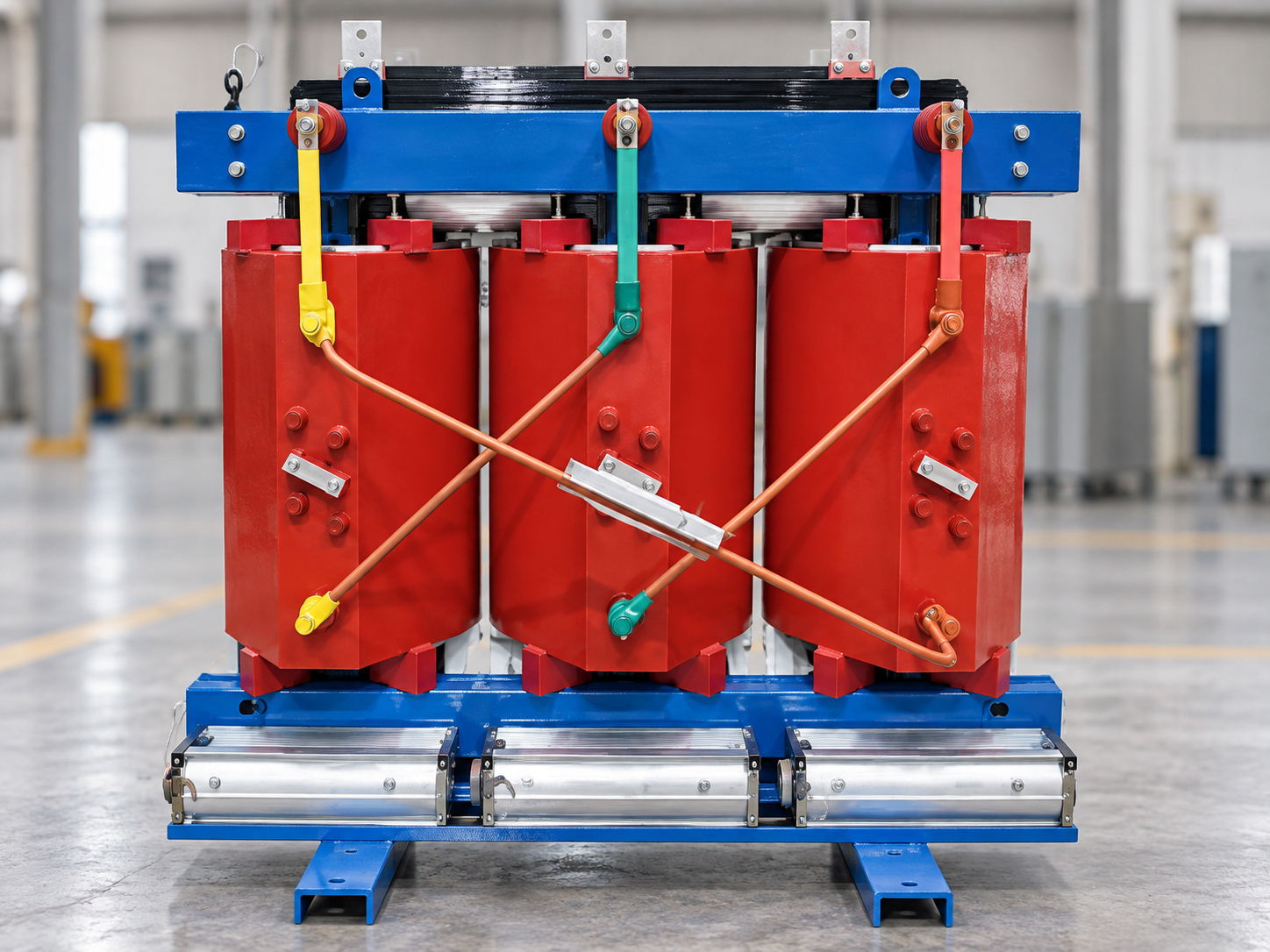
Use the conditions below to turn a broad “dry-type transformer” request into a reviewable specification.
| Project condition | Selection question | Evidence to request |
|---|---|---|
| Clean indoor room | Can an open ventilated unit operate in the expected dust and humidity? | Coil protection details, enclosure drawing and stated environmental limits |
| Moisture or contamination exposure | Which winding treatment and enclosure are specified for the actual exposure? | Applicable test reports or classification for the offered model and enclosure |
| Nonlinear or variable loads | Does the design cover the expected harmonic spectrum and neutral current? | Load assumptions, loss/thermal basis and any special design rating |
| Limited room or difficult access | Can the unit be installed, ventilated, inspected and later removed? | Outline drawing, lifting/transport dimensions, terminal access and required clearances |
| Efficiency-sensitive operation | Are competing quotations using comparable loss guarantees and test conditions? | No-load and load losses, guaranteed efficiency and applicable compliance basis |
For a quick comparison of dry construction and liquid-filled options, see our dry-type vs oil-immersed transformer guide. When reviewing a specialized product label such as “dry-type triplex,” consult the dry-type triplex transformer guide and confirm the manufacturer’s drawings; the label is not a substitute for a connection diagram.
Standards and Regulatory Scope
IEC 60076-11:2018 covers a defined group of dry-type power transformers. Its published scope includes units with highest voltage for equipment up to and including 72.5 kV and at least one winding above 1.1 kV, with listed exclusions. Do not assume every special-purpose or low-voltage unit falls within that scope. Confirm the exact standard and edition named by the project specification.
In the United States, Title 10 CFR Part 431 Subpart K uses a separate definition for “distribution transformer” and sets conservation requirements for covered equipment. The current rule includes voltage, frequency, capacity and equipment-type boundaries and exclusions; it is not a general definition of all dry-type transformers. For international procurement, identify the jurisdiction, adopted code, product standard and contract edition instead of treating one country’s rule as universal.
Standards compliance should be tied to the offered model and documented tests. If the project requires climatic, environmental, fire-behavior, seismic, short-circuit or efficiency evidence, state exactly which rating or test is required and ask for the applicable report. A family brochure or a declaration for another model is not equivalent to project-specific evidence.
Installation, Commissioning and Maintenance
Installation, inspection, testing and energized work belong to qualified personnel following the applicable code, approved drawings and manufacturer instructions. Before energization, confirm that the delivered nameplate matches the approved submittal, connections and tap setting are documented, protection settings are coordinated, grounding is complete and the cooling path is unobstructed.
Maintenance intervals depend on the environment, loading and manufacturer instructions. A practical inspection program can record dust accumulation, blocked ventilation, fan operation, abnormal noise, discoloration, loose or damaged connections, alarm history and observed room conditions. Do not clean or test energized equipment unless the approved safety procedure and applicable rules explicitly permit the activity.
Save baseline commissioning values and the final data sheet with the equipment record. Compare later observations with that baseline, and investigate a change rather than assuming it is normal. If a component, fan, enclosure or room condition changes, check whether the approved thermal and protection assumptions still hold. For a separate overview of test methods and their limits, see our transformer testing guide.
Dry-Type Transformer RFQ Checklist
A clear RFQ lets suppliers quote the same duty and makes deviations visible. Include the site and load information below, then request a completed schedule with exceptions clearly marked.
| RFQ item | Information to provide or request |
|---|---|
| Electrical rating | kVA, primary/secondary voltages, phase, frequency, connection, vector group, taps and neutral/grounding requirements |
| Load duty | Load profile, power factor, motor starting, nonlinear loads, harmonic spectrum and future growth assumptions |
| Construction | Open ventilated, VPI, cast resin or another defined construction; state which windings are treated or encapsulated |
| Environment | Indoor/outdoor, ambient, altitude, dust, moisture, condensation, corrosion, fire strategy and enclosure requirement |
| Performance | Impedance, losses, guaranteed efficiency, temperature rise, insulation system, sound, cooling mode and applicable tolerances |
| Mechanical interfaces | Outline drawing, mass, lifting points, cable entry, terminal position, anchoring and required service/air clearances |
| Protection and monitoring | Sensors, alarms, trips, fans, control voltage, terminals and interface drawings |
| Verification documents | Nameplate, routine/type/special test reports as specified, installation manual, exceptions list and revision-controlled drawings |
For broader transformer fundamentals, review the transformer fundamentals guide. For general site-work context, see the transformer installation and maintenance guide, then follow the manual for the exact model.
Dry-Type Transformer Explained
The GATE Conqueror engineering-education channel’s “Very Good Interview Qn || What is Dry Type Transformer, Its Applications & Challenges || KN Rao Sir” is supplemental learning, not a product specification, design approval or field procedure.
Watch the dry-type transformer lesson on YouTube.
Frequently Asked Questions
Does a dry-type transformer contain insulating oil?
No. Its core and windings are not immersed in insulating liquid. Solid insulation and air-based cooling are used, though the exact construction varies by model.
Is cast resin always better than an open ventilated design?
No. Cast resin may fit a specified exposure or project requirement, while an open ventilated design may suit a clean, protected room. Compare the tested construction, enclosure, thermal conditions and maintenance needs for the installation.
Can a dry-type transformer be installed outdoors?
Only when the exact transformer and enclosure are designed and rated for the outdoor conditions. Confirm rain, dust, temperature, condensation, corrosion, ventilation and code requirements from the approved documents.
What information is needed to select a dry-type transformer?
Provide kVA, primary and secondary voltage, phase, frequency, connection, load profile, environment, enclosure, cooling, losses, impedance, sound and installation constraints. Ask for model-specific drawings, guaranteed data and test documentation.
Technical References
- IEC 60076-11:2018 — Power transformers, Part 11: Dry-type transformers. Scope, exclusions and applicability of the dry-type power transformer standard.
- eCFR, Title 10, Part 431, Subpart K — Distribution Transformers. Current U.S.-specific regulatory definitions and conservation requirements for covered distribution transformers.
Conclusion
The right dry type transformer is the one whose construction, electrical rating, thermal behavior, enclosure and environmental limits match the actual project. Compare the same operating conditions across quotations, review the drawings and guaranteed data, and retain the approved documents for installation and maintenance.