
A written transformer preventive maintenance schedule keeps industrial power systems boring—in the best sense: no surprise outages, no emergency repairs, no unexplained aging.
Facilities teams need intervals, task lists, and records more than heroics. This guide provides a workable schedule frame and explains what each task catches.
Adapt the intervals to duty, environment, and criticality with your maintenance engineer.
Part 1. Why scheduled beats reactive
Transformer failures develop slowly—moisture ingress, loose connections, blocked cooling—then finish fast.
Scheduled inspections catch the slow phase, when fixes cost hours instead of weeks of downtime.
For related context, see the monitoring methodologies for oil immersed transformers.
For related context, see the loading guide for oil immersed power transformers.
Part 2. A schedule frame to adapt
Start from this frame and shift intervals with duty, dust, humidity, and criticality.

| Interval | Typical tasks |
|---|---|
| Monthly | Visual check: oil level, leaks, silica gel color, unusual noise, cooling airflow |
| Quarterly | Infrared scan of terminations under load; clean ventilation paths; record loading and temperatures |
| Annual | Oil sample for dielectric strength, moisture, acidity; protection and alarm function tests; earthing check |
| Every 2-4 years | DGA trend review, tap changer service per manual, gasket and bushing inspection |
| Condition-based | Filtration, drying, retightening, or detailed testing triggered by trends |
The unit manual and the site standard govern; the table is a starting frame, not a rule.
Part 3. Visual and thermal inspections
Most developing faults announce themselves visually: weeping gaskets, discolored silica gel, dust mats on dry-type windings, corrosion on radiators.
Infrared scanning under load finds loose terminations before they carbonize.
Keep photos with each inspection so drift stays visible across visits.
Part 4. Oil sampling and electrical tests
Annual oil tests track dielectric strength, moisture, and acidity against the commissioning baseline; DGA adds the incipient-fault view on the interval your criticality justifies.
Electrical testing—insulation resistance, ratio, winding resistance—follows the manual periodicity or any protection trip.
Trend results rather than judging single values; the slope tells the story.
Part 5. Records, spares, and responsibility
A maintenance log per unit—inspections, results, corrective actions—turns opinions into evidence when budgets are argued.
Stock the consumables that stop small findings from waiting on freight: silica gel, gaskets, indicator glasses, touch-up paint.
Name one owner for the schedule; shared responsibility reliably becomes no responsibility.
Part 6. Product recommendation and Fit Boundary
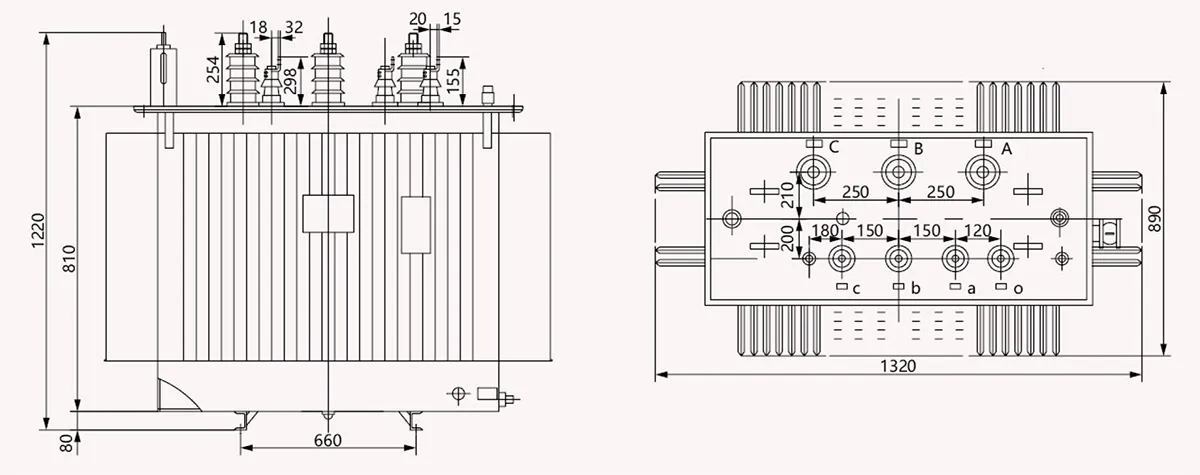
Product recommendation: Maintainability differs by series—review accessory and access design before standardizing a fleet. Start at the transformer product category, then review the S□-M oil-immersed power transformer series and the SC(B) resin insulated dry transformer series against the approved specification.
| Better fit | Poor fit without extra study |
|---|---|
| Facilities with named maintenance ownership | Fleets maintained only after alarms |
| Sites trending oil and thermal results | Single-value judgments without baselines |
| Teams stocking basic consumable spares | Waiting on freight for silica gel and gaskets |
Submit the rated kVA and voltage combination, vector group and tap range, no-load and load losses, cooling method and enclosure, and short-circuit impedance target through Contact Us for model-specific confirmation.
Part 7. Common maintenance mistakes
- Running silica gel breathers saturated for months.
- Scanning terminations at no load and calling them healthy.
- Sampling oil without recording temperature and loading.
- Deferring protection function tests because production is busy.
- Losing the commissioning baseline and trending against nothing.
- Treating the schedule as fixed when duty or environment changes.
FAQ
How often should distribution transformers be inspected?
Monthly visual checks suit most industrial duty, with quarterly thermal scans and annual testing; criticality and environment adjust the frame.
Which tasks belong in annual transformer maintenance?
Oil sampling and testing, protection and alarm function tests, earthing verification, and a documented condition review.
When is oil sampling required?
Annually for most industrial units, after any protection trip, and whenever temperature or loading behavior changes without explanation.
What electrical tests support preventive maintenance?
Insulation resistance, transformation ratio, and winding resistance, compared against factory and commissioning values.
Can maintenance intervals be extended with monitoring?
Partly—online monitoring supports longer intervals for some tasks, but visual inspection and protection tests keep their value.
What records should facilities keep?
A per-unit log of inspections, test results, corrective actions, and photos, anchored to the commissioning baseline.
Who should perform transformer maintenance tasks?
Trained electrical staff for inspections; oil laboratories and test crews with transformer experience for sampling and electrical testing.