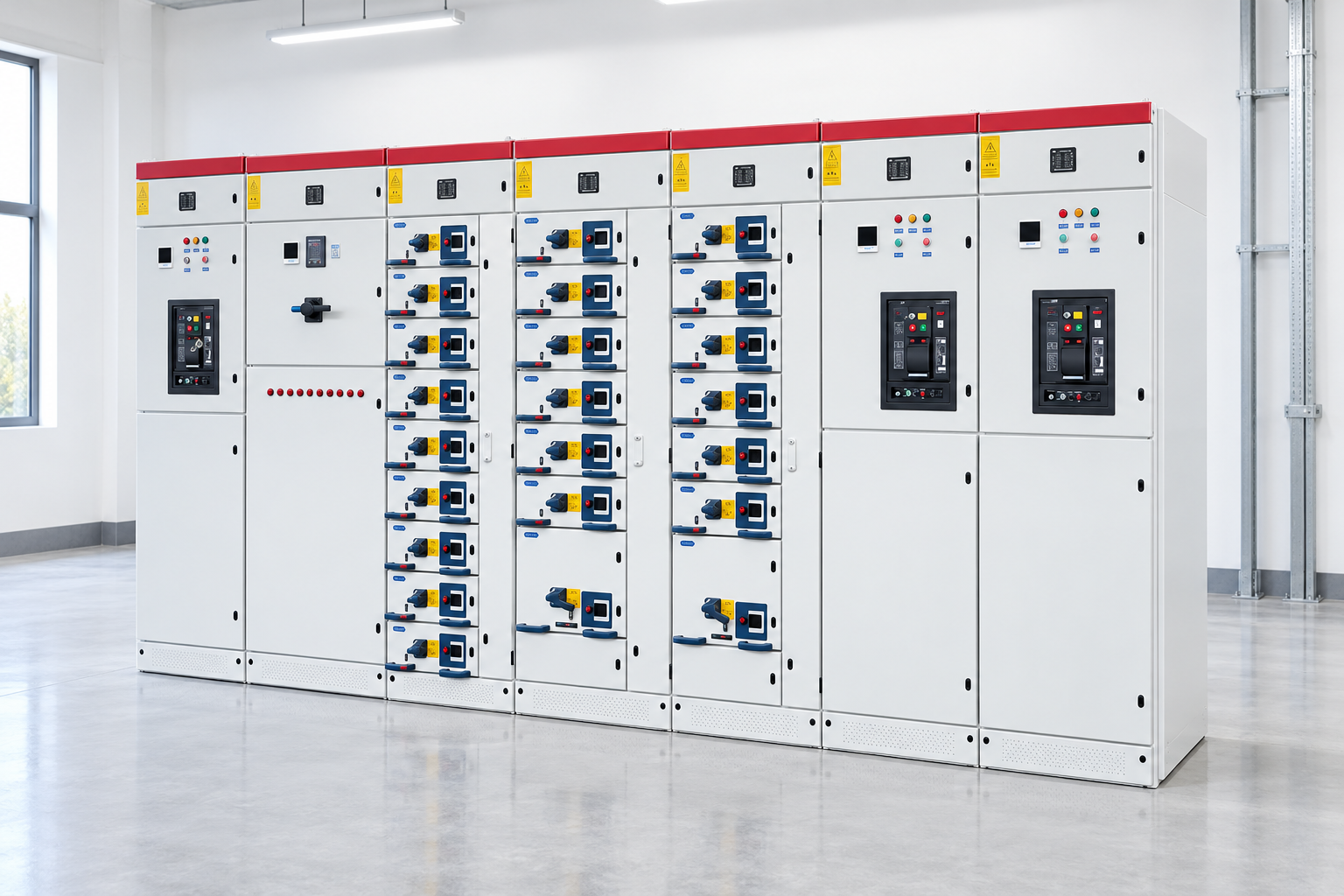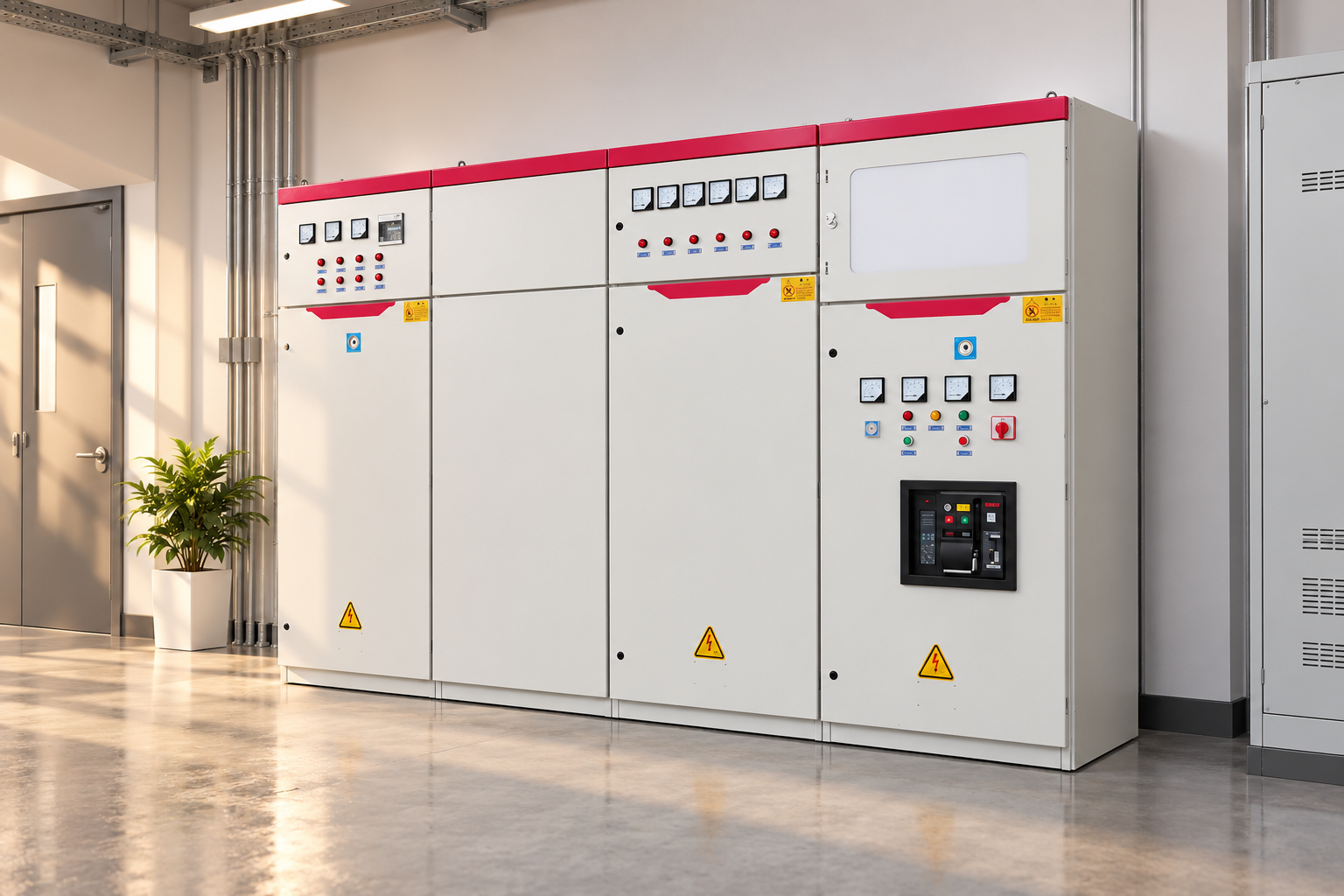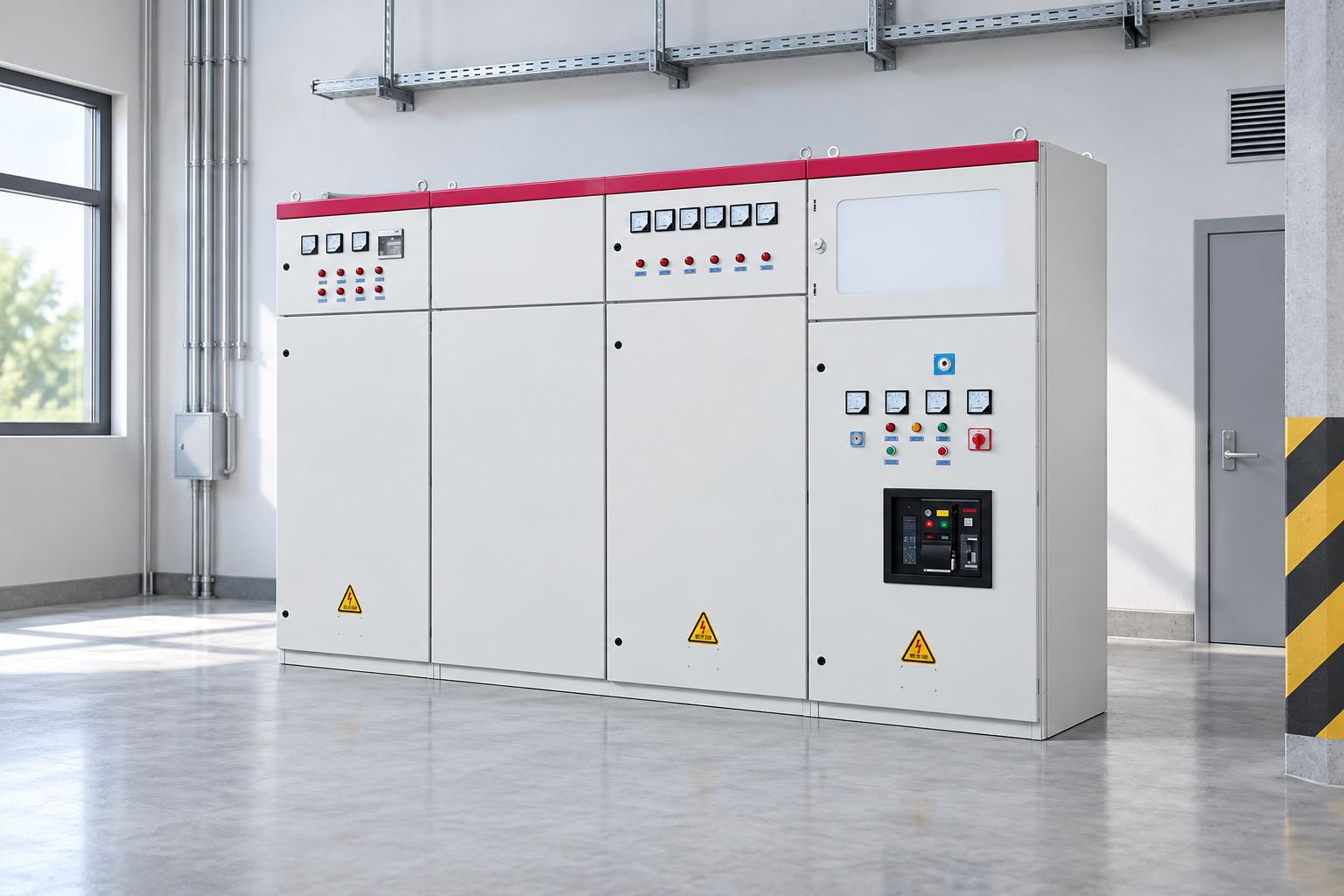

An electrical distribution panel receives power from an upstream source and divides it into protected outgoing circuits. Depending on size and standard, the equipment may be called a panelboard, distribution board, switchboard, main distribution panel or cabinet. This guide clarifies those terms and explains ratings, breakers, busbars, enclosure, grounding, form of separation and selection for fixed and portable systems.
What Is a Distribution Panel?
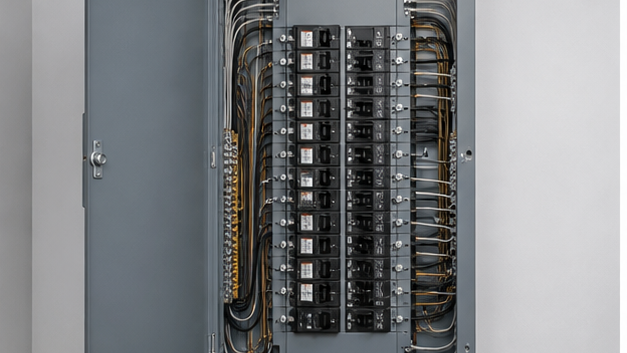
A distribution panel contains an incoming connection or main protective device, common busbars, outgoing circuit breakers or fuse switches, neutral and protective-earth bars, metering and an enclosure. It provides a controlled point for isolation and protection of downstream cables and loads.
The panel’s role depends on its location. A main distribution panel may receive a transformer secondary and feed large subpanels. A final panelboard feeds lighting, receptacles and small equipment. Both must be rated for voltage, current and prospective fault duty.
Panelboard vs Switchboard vs Switchgear
A panelboard commonly uses a wall-mounted cabinet with branch breakers accessible from the front. A switchboard is usually a floor-mounted assembly with larger mains, busbars and feeder sections. Switchgear generally emphasizes compartmentation, drawout devices, higher fault duty and maintainability. Exact definitions vary by IEC, UL and regional practice, so procurement should cite the required product standard and construction.
Quick Comparison and Selection Table
Use this table as a quick review of the main engineering and procurement decisions explained in the article.
| Decision area | Practical meaning | What to verify |
|---|---|---|
| What Is a Distribution Panel? | A distribution panel contains an incoming connection or main protective device, common busbars, outgoing circuit breakers or fuse switches, neutral and protective-earth bars, metering and an enclosure. | It provides a controlled point for isolation and protection of downstream cables and loads. |
| Panelboard vs Switchboard vs Switchgear | A panelboard commonly uses a wall-mounted cabinet with branch breakers accessible from the front. | A switchboard is usually a floor-mounted assembly with larger mains, busbars and feeder sections. |
| Essential Panel Ratings | State rated operational voltage, frequency, phase and wire system, busbar current, neutral rating, short-circuit withstand or conditional rating, main and feeder breaking capacity, enclosure IP/NEMA rating, ambient… | For assemblies verified with a specific protective device, substitutions may invalidate the short-circuit rating. |
| Main vs Branch Distribution Panels | The main panel is close to the service, generator or transformer and usually has the highest current and fault level. | It may contain a bus coupler, automatic transfer, power-factor correction or large motor feeders. |
| Panel Enclosure and Cabinet Design | Indoor dry locations may use ventilated steel cabinets; outdoor, dusty, wet or corrosive sites need enhanced sealing and materials. | Enclosure design must manage heat without admitting contaminants. |
Main Distribution Panel Components
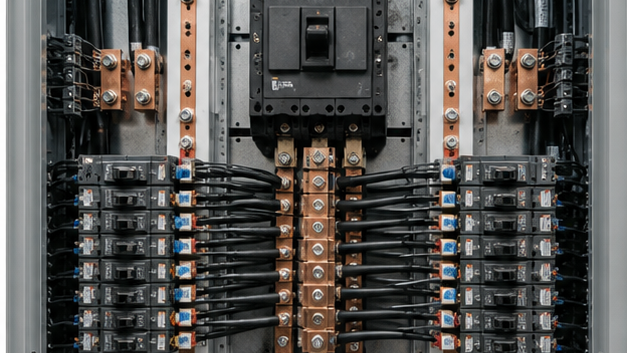
- Main breaker or switch: isolates the panel and provides overcurrent protection where required.
- Busbars: carry current to outgoing devices and withstand thermal and electrodynamic fault forces.
- Feeder breakers: protect downstream conductors and loads.
- Neutral bar: carries neutral current and may need full or increased rating for nonlinear loads.
- Protective-earth bar: bonds exposed conductive parts to the earthing system.
- Metering and SPD: monitor electrical quantities and limit transient overvoltage.
- Enclosure and barriers: provide mechanical, environmental and touch protection.
Essential Panel Ratings
State rated operational voltage, frequency, phase and wire system, busbar current, neutral rating, short-circuit withstand or conditional rating, main and feeder breaking capacity, enclosure IP/NEMA rating, ambient temperature and applicable standard. For assemblies verified with a specific protective device, substitutions may invalidate the short-circuit rating.
Continuous current must account for demand, diversity, temperature rise and future load. Short-circuit rating must exceed the available fault current at the installation. A high breaker interrupting rating does not automatically prove the complete panel busbar and assembly rating.
Main vs Branch Distribution Panels
The main panel is close to the service, generator or transformer and usually has the highest current and fault level. It may contain a bus coupler, automatic transfer, power-factor correction or large motor feeders. Branch panels are closer to loads and contain more smaller circuits.
Selective coordination should allow a branch breaker to clear a downstream fault without opening the main breaker. Time-current curves, instantaneous settings and current-limiting performance must be reviewed against cable and equipment withstand.
How to Select a Circuit Breaker Distribution Panel
- Define voltage, phase, wire system and grounding arrangement.
- Calculate diversified load and required busbar current.
- Obtain maximum and minimum fault current.
- Select main and branch breakers for load, cable protection and coordination.
- Choose number of ways plus planned spare capacity.
- Specify neutral, earth bar, surge protection and metering.
- Set enclosure, form of separation, access and environment requirements.
- Confirm cable entry, lug size, bending space and mounting.
Panel Enclosure and Cabinet Design
Indoor dry locations may use ventilated steel cabinets; outdoor, dusty, wet or corrosive sites need enhanced sealing and materials. Enclosure design must manage heat without admitting contaminants. Cable glands, doors, vents and interfaces are part of the rating, not afterthoughts.
Form of separation or compartmentation can limit contact with adjacent functional units and support maintenance, but it does not eliminate arc-flash hazards. Interlocks, shutters, remote operation and arc-resistant construction may be appropriate for higher-energy systems.
Portable Power Distribution Panels
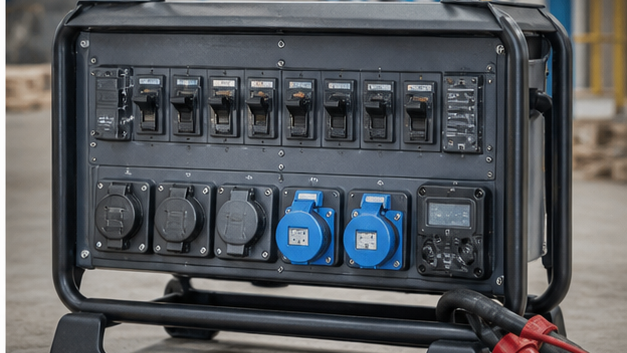
Portable panels distribute temporary power at construction sites, events, maintenance shutdowns and industrial work areas. They require impact-resistant, weather-suitable construction, protected plugs and receptacles, strain relief, overcurrent protection, residual-current protection where required and clear source/voltage identification.
Integration With Transformers and Switchgear
A main LV panel may be integrated with a transformer and MV compartment in a YBM-12 prefabricated substation. Its upstream feeder can originate from KYN28A-12 medium-voltage switchgear or a compact LBHB-12 ring main unit. Transformer impedance, secondary fault current and protection settings must be coordinated with the LV main board.
Inspection, Testing and Maintenance
- Verify assembly against the approved single-line and wiring diagrams.
- Inspect device ratings, conductor sizes, clearances and labels.
- Check terminal torque and mechanical operation.
- Test insulation, protective conductors, breakers, interlocks and metering.
- Perform functional and trip tests for protection and transfer logic.
- Use thermography under representative load after commissioning.
- Keep covers closed, openings sealed and circuit schedules current.
Panel schedules and commercial selection intent
Search results for distribution panels strongly favor exact product and rating information. A useful panel schedule lists supply voltage, phases, main rating, fault rating, neutral and earth arrangement, outgoing breaker count, spare ways, metering, enclosure rating, cable entry and applicable assembly standard.
Panelboard, switchboard or switchgear decision
Choose by current and fault duty, device construction, operator access, maintenance method and installation space—not by local naming habits. A wall-mounted panelboard suits many branch circuits; a floor-standing switchboard supports larger distribution duties; switchgear adds construction and interruption features for higher reliability and fault-control requirements.
Technical references and further reading
The following independent sources support the standards, terminology, calculations, and safety context discussed in this guide:
- IEEE C37.121 unit substation requirements — Guidance for coordinating transformer, incoming, outgoing, and transition equipment in distribution substations.
- NIST SI units for electric current — Reference definitions for current, voltage, resistance, and power used in distribution calculations.
- OSHA power transmission and distribution safety — Official overview of important safety differences and practices in transmission and distribution systems.